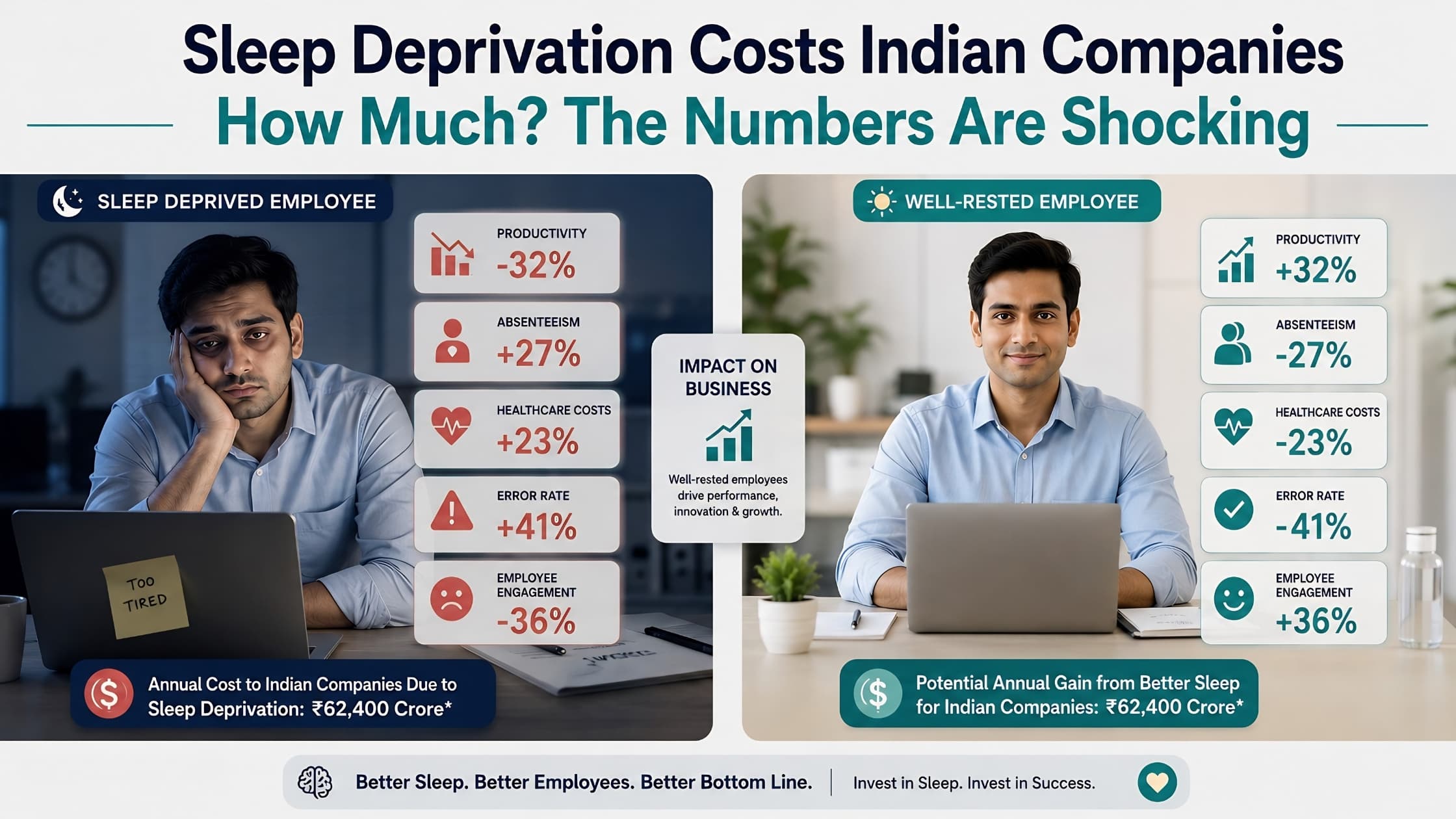
India Sleeps Less Than Almost Anyone on the Planet
Start with the baseline. Fitbit's Global Sleep Study, which analysed 3.9 billion nights of sleep data across dozens of countries, found that India has the shortest average sleep duration of any country in the dataset: 6 hours and 29 minutes per night. Japan and South Korea, which are typically cited as the world's most sleep-deprived populations, both sleep more than that.
The structural causes are not mysterious. Mumbai commuters average 58 minutes each way. Many Indian cities have dense, noisy living environments that make early sleep difficult. And there is a cultural dimension: late social activities — dinners, family events, scrolling — followed by early professional start times create a daily sleep deficit that most people simply accept as normal.
The WHO recommends 7 to 9 hours for adults. The gap between that and 6 hours 29 minutes might not sound dramatic. Over a working year of 250 days, it adds up to roughly 188 missed hours of sleep — the equivalent of nearly 24 full working days.
The Productivity Math Is Uncomfortable
The RAND Corporation's 'Why Sleep Matters' study is probably the most-cited research on the economic cost of sleep deprivation. RAND's methodology links sleep duration to measurable productivity outcomes and then applies those outcomes to workforce size and salary data. The results for the US were striking: $411 billion in annual economic losses attributable to sleep deprivation.
When the same framework is applied to India's working population — with a lower average sleep duration and a workforce of comparable scale — the numbers are proportionally large. RAND's productivity findings are the relevant anchor:
- Employees sleeping 6–7 hours per night show 9% lower productivity than those sleeping the recommended 7–9 hours.
- Employees sleeping fewer than 6 hours show a 23% productivity drop.
Run that against a realistic corporate scenario. Take a 500-person organisation. Average corporate salary: Rs 12 lakh per annum. If 60% of employees are sleeping below the optimal threshold — a conservative estimate given India's baseline — and most are in the 6-to-7-hour band:
Per employee annual cost: Rs 1.08 lakh (9% of Rs 12 lakh)
Employees affected: 300 (60% of 500)
Total annual productivity loss: Rs 3.24 crore
That figure does not include employees sleeping under six hours, where the productivity hit is 23%. It does not include senior roles where the cost per percentage point of lost performance is considerably higher. And it does not include the healthcare dimension — which adds its own layer of cost.
This Is Also a Healthcare Problem — and a Liability One
Productivity loss is the visible part of the iceberg. What sits below the surface is a set of health consequences that translate directly into insurance claims, absenteeism, and long-term attrition.
The RAND study found that employees who regularly sleep fewer than six hours per night carry a 13% higher mortality risk than those sleeping seven or more. More immediately relevant to HR teams and CFOs:
- Sleep-deprived employees have 50% more workplace accidents than rested colleagues.
- The incidence of depressive symptoms is 39% higher among chronically under-slept workers.
- Cardiovascular risk increases substantially with sustained sleep deficit — a slow-burn cost that shows up in group health insurance claims years down the line.
Consider what this looks like in practice. A fatigued employee in a manufacturing or logistics role is statistically more likely to be involved in a workplace incident. A fatigued employee in a knowledge-work role makes worse decisions, catches fewer errors, and communicates less effectively — none of which shows up cleanly on a productivity dashboard, but all of which shows up in outcomes.
Organisations that self-insure or run group health plans absorb these costs directly. Those that do not still feel them through absenteeism rates, attrition, and the slower, less measurable drag of a workforce operating well below its cognitive ceiling.
What a Corporate Sleep Wellness Programme Actually Looks Like
Most HR teams, when they think about sleep as a wellness issue at all, default to a single webinar and a pamphlet about screen time before bed. That is not a programme — it is a checkbox. Effective sleep wellness intervention has three layers, and they operate at different timescales.
Layer 1: Education
Most employees genuinely do not know the specific cognitive and physiological effects of their sleep deficit. They know they are tired. They do not know that six hours of sleep for two weeks produces cognitive impairment equivalent to 48 hours of total sleep deprivation, or that this impairment goes largely unnoticed by the person experiencing it. Evidence-based education changes the motivation to change behaviour. It is low-cost and measurably effective.
Layer 2: Behavioural Tools
This is where digital tools do the heavy lifting: sleep trackers that establish a personalised baseline, CBT-I (Cognitive Behavioural Therapy for Insomnia) modules that address the psychological patterns behind poor sleep, and personalised sleep hygiene recommendations that account for shift patterns, commute lengths, and chronotype. Self-paced and mobile-accessible tools have the best completion rates in the Indian corporate context, where employees are frequently time-poor and geographically distributed.
Layer 3: Structural Enablement
No amount of education fixes a culture where 8:00 AM all-hands meetings are standard, where late-night Slack messages from managers are expected to be read, or where long commutes make going to bed at a reasonable hour mathematically impossible. Flexible start times, commute reduction policies, and meeting norms that respect the employee's sleep window are organisational culture decisions. They are harder to implement than a wellness app, but their impact compounds.
The ROI Case for Acting Now
A well-designed corporate sleep wellness programme — education, digital tools, and basic structural changes — costs a fraction of the productivity loss it addresses. For the 500-person example above, even recovering 20% of the Rs 3.24 crore productivity gap returns Rs 64.8 lakh annually. Most sleep wellness programmes are priced well below that figure per employee per year.
The harder question is not whether the ROI is there — it clearly is. The harder question is why sleep is still treated as a personal lifestyle variable rather than an organisational performance lever in most Indian companies. The answer is probably that the cost is invisible: it does not show up on one line in the P&L. It is diffused across slower throughput, higher healthcare claims, marginally worse decisions, and slightly elevated attrition. None of those things get attributed to sleep.
But they should.
Final Thought
India has a structural sleep deficit. It is not a fringe issue or a wellness trend — it is a measurable drag on workforce performance that shows up in the productivity research, the health data, and, for anyone willing to run the numbers, the financials.
HR teams that treat sleep as a wellness priority in 2026 are not doing something progressive. They are doing something obvious — and getting ahead of a cost their competitors are still absorbing silently.
The intervention does not need to be complex. Start with education. Add digital tools. Begin the harder conversation about structural enablement. The payoff is not hypothetical.