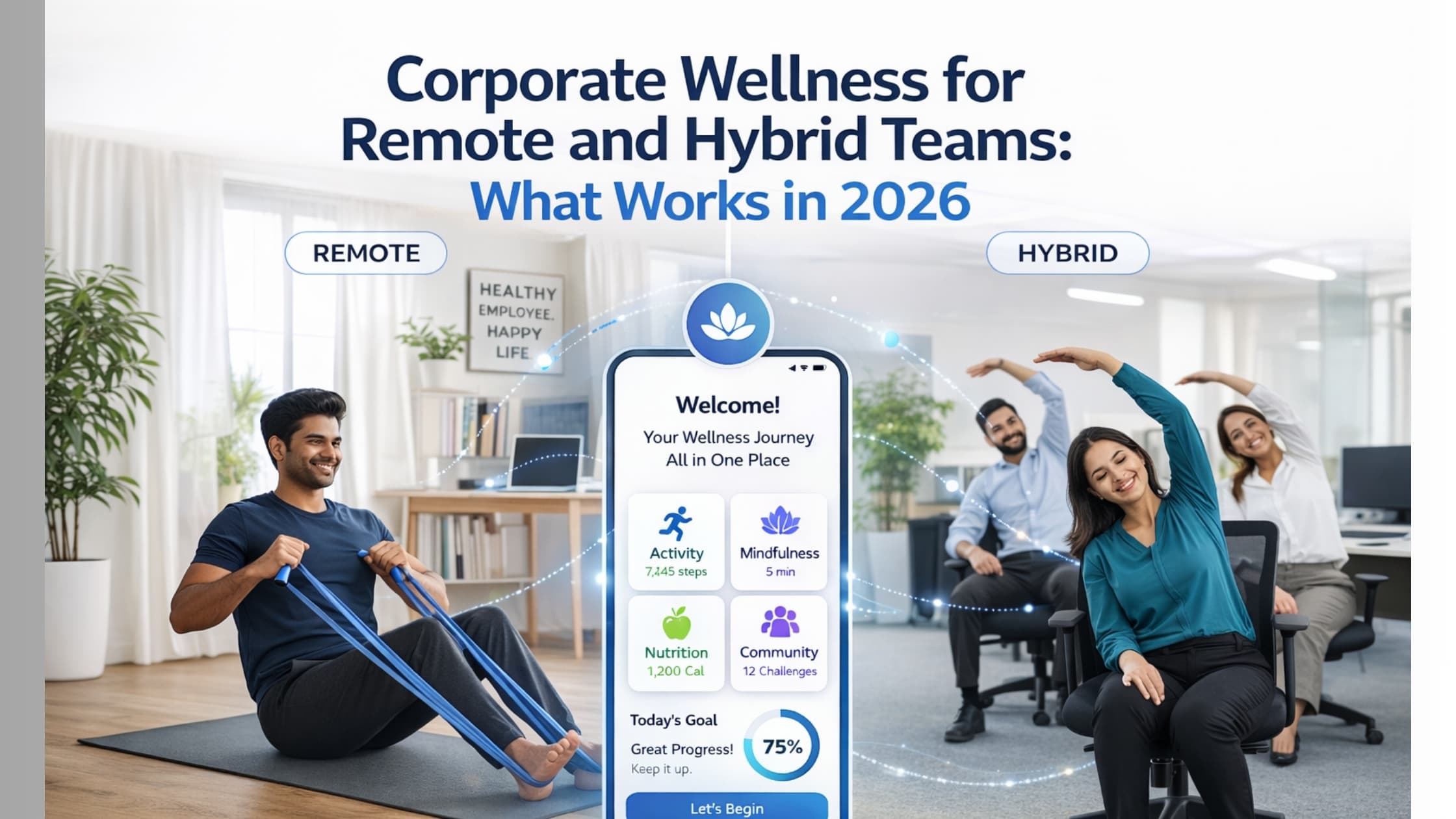
The hybrid workforce in India is now a permanent reality, not a pandemic experiment. As of 2025, 38% of India's corporate workforce operates in a hybrid model, and 11% is fully remote. The wellness challenge for these employees is different from in-office populations in ways that most wellness programs have not caught up with.
The Unique Wellness Challenges of Hybrid and Remote Work
Microsoft's 2025 Work Trend Index found that hybrid employees are 23% more likely to report blurred work-life boundaries than fully in-office peers, and 31% more likely to report social isolation. In India, the home-office dynamic adds additional layers: most Indian homes were not designed for full-time work, creating ergonomic challenges that are common in Western remote-work contexts and compounded by the reality of extended families sharing space, inconsistent internet infrastructure outside metros, and the absence of the social infrastructure that makes in-office work human.
Remote managers face their own challenges: limited visibility into employee wellbeing, reluctance to ask direct questions about mental health in a culture where such conversations can feel intrusive, and the difficulty of distinguishing disengagement from burnout before it becomes a retention crisis.
Digital-First Tools That Drive Engagement
For remote and hybrid wellness, the delivery mechanism matters as much as the content. Programs dependent on in-person participation systematically exclude remote employees — which means they systematically exclude the population at highest wellness risk. The tools that work for hybrid populations share three characteristics: mobile-first access (the smartphone, not the office computer, is the constant), asynchronous availability (support accessible at 10pm, not just during business hours), and low-friction entry (one tap to a meditation, not a five-step login process).
Engagement data from Humanova's hybrid client cohort shows that remote employees who access wellness support primarily on mobile have 2.8x higher monthly engagement than those using desktop-only access. Push notifications timed to common stress points (Monday morning, Wednesday afternoon slump, Friday end-of-day) increase weekly active use by 34%.
Manager Enablement: The Highest-Leverage Intervention
For hybrid teams, the manager is the primary wellness touchpoint. Research from Gallup shows that managers account for 70% of the variance in team engagement scores. For remote employees, the manager relationship is even more concentrated — there are fewer organic connection opportunities to distribute the relationship load. Managers who receive training in wellbeing conversations, early distress recognition, and signposting to resources have teams with 19% lower burnout rates and 14% lower turnover than untrained peers.
Effective manager training for hybrid wellness: keep it short (two to four hours, not two days), make it practical (role-play the conversation, not just theory), and update it annually as the remote-work context evolves. The specific skills that matter: asking open rather than leading questions ('How are you finding the current workload?' not 'Everything okay?'), recognizing behavioral signals of distress (late submissions, shorter messages, camera-off patterns), and knowing what resources exist and how to refer without making it feel like a HR incident.
Engagement Tactics That Work for Distributed Teams
Virtual wellness challenges are among the highest-engagement activities for distributed teams when designed well. Key design principles: team-based rather than individual (social accountability increases completion by 40%), visible progress (leaderboards, group trackers), low time commitment per day (five to ten minutes of activity, not hour-long commitments), and variety (rotating challenge types — step challenges, hydration, sleep, gratitude journaling — maintain interest across a quarter).
Conclusion
Hybrid wellness is not about taking your in-office program and putting it on Zoom. It requires a different delivery architecture, stronger manager infrastructure, and genuine empathy for the specific stressors of working from home in the Indian context. Organizations that design for the hybrid-first reality — rather than treating remote employees as office employees who happen to be elsewhere — build significantly stronger wellness outcomes across both populations.