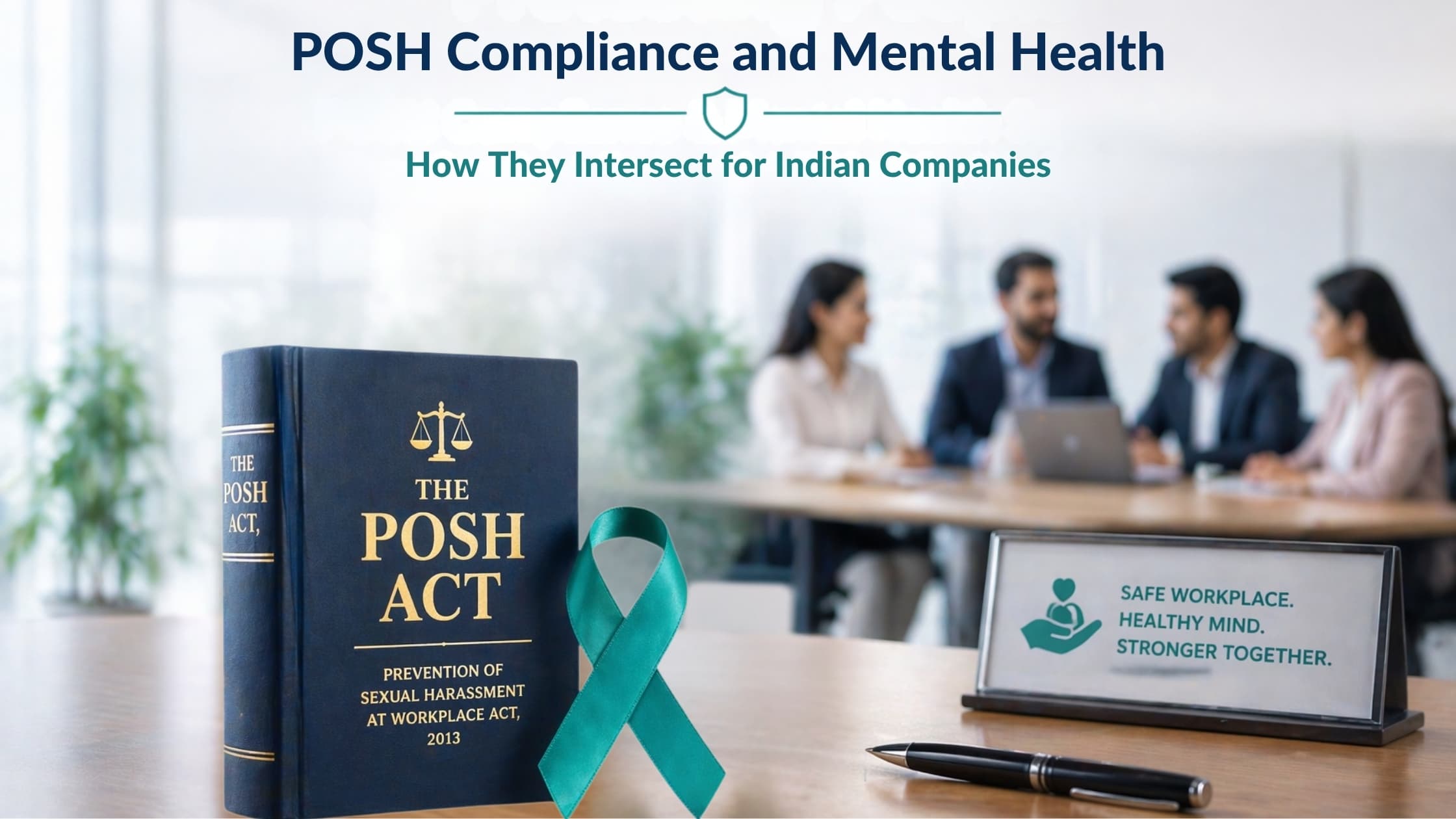
This is not a hypothetical. It is one of the most common endings to workplace sexual harassment cases in India — and it points to a blind spot that organizations can no longer afford to ignore. POSH compliance, as most companies practice it, stops at the legal minimum. The mental health dimension of workplace harassment is left almost entirely unaddressed.
That gap is becoming a liability. Here is what Indian organizations need to understand about the intersection of POSH compliance and employee mental health — and what they actually need to do about it.
The Legal Framework: Two Acts, One Problem
The Prevention of Sexual Harassment Act, 2013 — commonly known as the POSH Act — applies to every organization in India with ten or more employees. It requires companies to constitute an Internal Complaints Committee (ICC), run annual awareness programs for employees, and submit an annual compliance report to the District Officer.
Most HR teams are reasonably familiar with these requirements. What is far less understood is how the POSH Act intersects with a separate piece of legislation: the Mental Healthcare Act, 2017. The Mental Healthcare Act places obligations on employers to maintain workplaces that are safe, non-discriminatory, and free from conditions that contribute to mental illness.
Here is the problem: workplace sexual harassment is not just a conduct issue. It is a documented cause of clinical anxiety, post-traumatic stress disorder, and depression. When you put those two things together — that sexual harassment causes mental illness, and that employers are legally obligated not to contribute to mental illness — the conclusion is not comfortable for organizations that treat POSH as a checkbox exercise.
What the Research Actually Shows
This is not speculation. A 2023 study published in the Indian Journal of Psychiatry tracked employees who had experienced workplace sexual harassment and found the following:
- 67% reported clinical anxiety symptoms in the six months following the incident
- 43% reported depressive symptoms during the same period
- Only 18% accessed any professional mental health support
That last number is the one that should stop HR leaders cold. More than four in five employees who experience harassment and develop clinical symptoms never get help. The gap is not because support does not exist — it is because organizations do not make it available, accessible, or normal to seek.
The downstream consequences of that gap show up in ways that organizations do feel, even when they do not connect them to the original incident. Employees who navigate the ICC process without concurrent mental health support show significantly worse outcomes than those who have access to counseling. They are more likely to leave the company even after a successful investigation outcome. They return to full productivity more slowly, or not at all. And in a small but growing number of cases, they pursue legal action against the employer for failure to provide adequate duty-of-care support during the process.
Think about what that means. A company can do everything the POSH Act requires and still face legal exposure — because the law has moved further than the compliance checklist.
The Legal Grey Zone Most Companies Are In
Here is the honest situation: the POSH Act does not explicitly require organizations to provide mental health support to complainants. So many companies have concluded they are not required to. That logic has a flaw.
Common law duty of care, combined with the Mental Healthcare Act's employer obligations, creates what courts have increasingly described as a practical — if not statutory — requirement. Organizations with POSH processes that exclude any mental health support pathway are operating in territory that courts have been willing to enter when complainants bring claims.
This is not a theoretical risk anymore. Employment law practitioners in India are increasingly advising clients that the failure to offer mental health support during ICC proceedings is a foreseeable harm — and that foreseeability is exactly the standard courts use to determine liability.
What Good Practice Actually Looks Like
Organizations that take this seriously — and a growing number are starting to — are implementing the following as baseline standards:
- Confidential counseling access for both parties. This means the complainant and the respondent. The emotional weight of being either party in an ICC proceeding is real, and mental health support is not an admission of wrongdoing — it is appropriate care.
- Trauma-informed ICC member training. The way an ICC handles a complainant in the first interaction often determines whether she stays engaged in the process or withdraws. Members without trauma-informed training frequently cause unintentional harm through tone, process design, and questioning style.
- Post-resolution follow-up. The investigation closing is not the end of the psychological process. A 30-day and 90-day check-in — ideally through a confidential channel — costs very little and matters considerably.
- Mental health impact as a factor in remedies. If the ICC has discretion in recommending penalties or remedies, documented psychological harm to the complainant should be part of that consideration. Many ICCs do not currently factor this in at all.
Why Wellness Programs Are the Right Infrastructure
One of the more practical insights to emerge from organizations that have figured this out: the infrastructure for POSH-linked mental health support does not need to be purpose-built. It already exists — or should exist — inside a well-designed corporate wellness program.
Consider what employees who file POSH complaints actually need: confidential access, no-stigma entry, professional clinical support, and the ability to use it without their manager knowing. These are exactly the same features that make any corporate mental health or employee assistance program worth using.
Companies that already have functioning digital counseling access with anonymous entry and clinical-grade support can integrate POSH-related access into that infrastructure with relatively low friction. They do not need a separate budget line, a separate vendor, or a separate policy. They need a deliberate connection between the POSH process and the wellness program — something as simple as a trained ICC member saying: 'We have confidential counseling available to you through our wellness platform. Here is how to access it.'
Companies without that infrastructure face a harder problem. When a harassment incident occurs and there is no wellness platform, organizations find themselves trying to stand up mental health support in the middle of an active ICC process — which is expensive, slow, and visible in ways that can compromise confidentiality.
The Culture Question Underneath All of This
There is something uncomfortable worth saying directly: organizations that treat POSH compliance as a procedural exercise — a committee to constitute, a report to file, a training to schedule — are often the same organizations where harassment is more likely to go unreported in the first place. The compliance posture reflects the culture.
Psychological safety and POSH compliance are not separate workstreams. They are the same thing approached from different angles. An organization where employees feel genuinely safe speaking up, where managers are trained to handle disclosures carefully, and where mental health support is normal and accessible — that organization is both POSH-compliant in spirit and far less likely to face the situations where strict compliance becomes legally necessary.
This does not mean the procedure does not matter. The ICC, the timelines, the annual report — they matter. But they are the floor, not the ceiling. Organizations that treat them as the ceiling are, as courts are increasingly recognizing, exposed.
The Bottom Line
POSH compliance and mental health are not separate programs requiring separate budgets, separate champions, or separate strategies. The organizations handling both well have figured out that they are one integrated system — where the same culture of psychological safety that prevents harassment also provides the infrastructure to support people when prevention fails.
For Indian companies still treating POSH as a legal checkbox, the question is not whether the law requires mental health support. The question is whether they can afford the liability, the attrition, and the reputational damage of continuing to ignore it.
The answer, increasingly, is no.
Key Takeaways for HR and Compliance Teams
- The POSH Act and the Mental Healthcare Act 2017 together create a practical duty-of-care obligation for employer-provided mental health support during ICC proceedings.
- 67% of employees who experience workplace sexual harassment develop clinical anxiety symptoms — but fewer than 1 in 5 access any professional support.
- Employees who go through ICC proceedings without concurrent mental health support are more likely to leave, less likely to return to productivity, and more likely to pursue legal action.
- Confidential counseling, trauma-informed ICC training, post-resolution follow-up, and mental health-informed remedies are the minimum standard for defensible practice.
- Organizations with existing corporate wellness infrastructure can integrate POSH support at low cost — those without it face a harder, more expensive problem.
- POSH compliance and psychological safety culture are not separate workstreams. They reinforce each other — or they undermine each other.