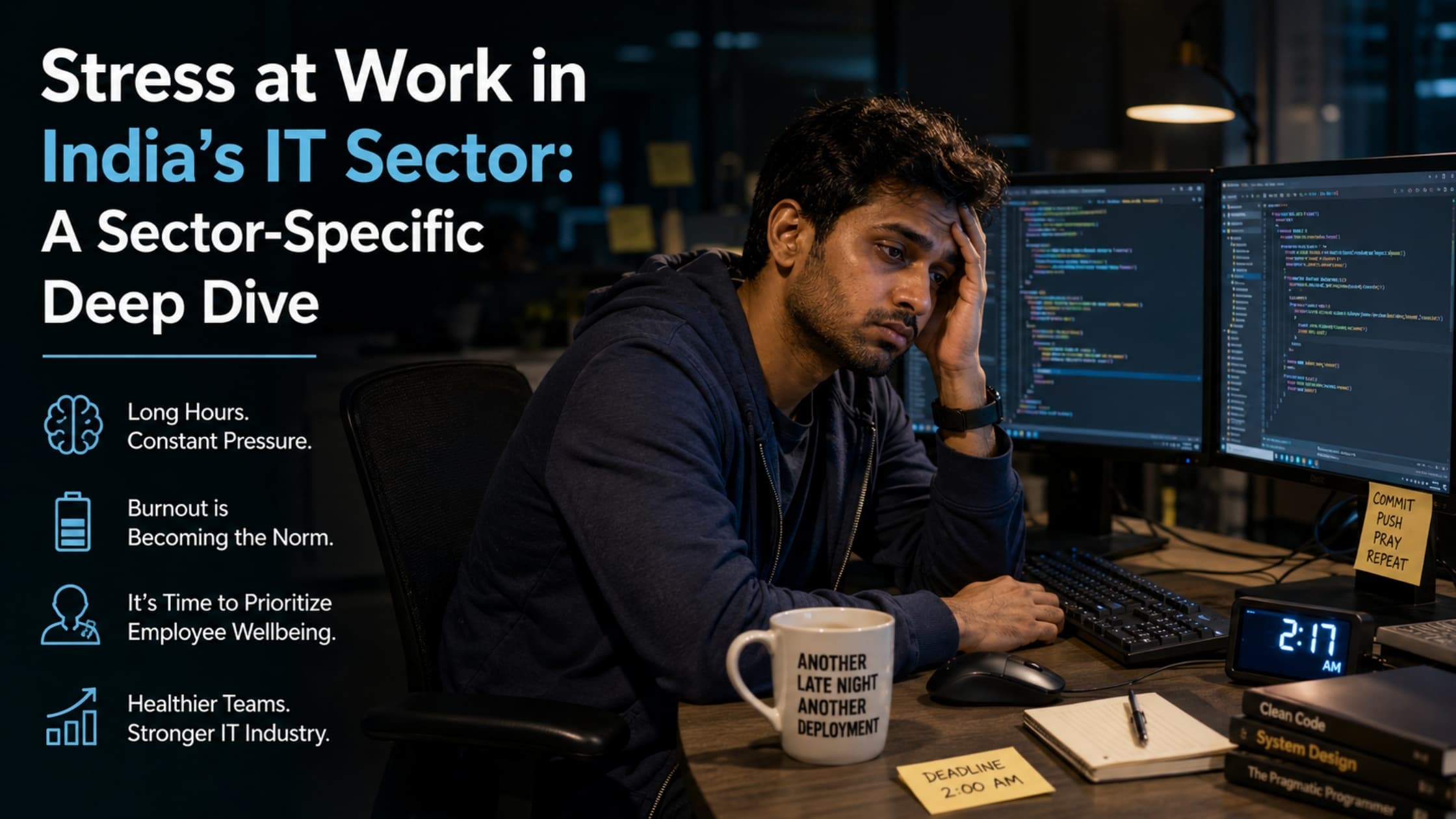
It is 11:47 PM in Pune. Arjun, a 29-year-old backend developer at a mid-sized IT services firm, is staring at a production alert that came in while he was eating dinner. His US client's deployment window opens in four hours. His team lead in Bengaluru is pinging him on Slack. His standup for the next sprint is scheduled for 9 AM tomorrow. He hasn't taken a full day off in eleven weeks.
Arjun's situation is not unusual. It is, statistically speaking, the norm.
India's IT sector directly employs approximately 5.4 million people, and it carries the country's highest documented burnout rates. Unlike sectors where stress data is vague or self-reported in isolation, IT has something unusual going for it: an HR and leadership culture that is analytically inclined, data-hungry, and genuinely invested in understanding what is going wrong. That makes the problem both more visible and more solvable than it might be elsewhere.
This piece goes deeper than the usual burnout statistics. It looks at the specific structural reasons why Indian IT employees burn out faster and harder than their global counterparts, and at the interventions that have actually shown measurable results — not in generic corporate settings, but in the specific context of how IT work in India operates.
The Numbers: What Makes Indian IT Different
The 2025 Nasscom-Deloitte Workforce Report found that 68% of Indian IT professionals show at least two clinical burnout indicators. Let that number land for a moment. Not two out of ten employees. Not a concerning minority. Nearly seven in ten.
For context: the figure is 53% across all Indian corporate sectors. Globally, the technology sector sits at 52%. Indian IT employees show higher burnout rates than their counterparts in the US (58%), the UK (55%), and Canada (49%). This is not a small gap. It is a structural signal.
The gap does not reflect a difference in personal resilience or work ethic. It reflects specific features of how Indian IT work is organized: the time zones it spans, the delivery models it runs, the support obligations it carries, and the remote-work conditions it now operates under. Each of those features layers additional stress onto an already high-pressure profession. Together, they produce numbers that should concern every HR leader and senior manager in the sector.
The Specific Stressors Driving IT Burnout in India
Generic wellness discussions tend to flatten industry-specific stress into a list of universal causes: long hours, poor management, unclear expectations. Those are real. But they miss the particular architecture of IT work that makes Indian employees especially vulnerable. Here is what the data actually points to.
1. Perpetual Sprint Cycles Without Recovery
Agile methodology, in its original design, includes genuine recovery sprints — periods where teams consolidate learning, address technical debt, and come up for air before the next delivery cycle begins. In practice, many Indian IT organizations run back-to-back delivery sprints, with planning for the next sprint beginning before the current one closes.
The cognitive reality of this is straightforward, and research from Carnegie Mellon backs it up: sustained sprint cycles without recovery intervals reduce cognitive performance by 23% over twelve weeks. Developers working in this model are not just tired. They are measurably less effective at exactly the kind of complex problem-solving their work demands. The irony is that sprint cultures intended to increase output reliably degrade it.
One senior engineering manager at a Hyderabad-based firm described it this way: "We tell developers the retrospective is their recovery time. But the retrospective is forty-five minutes of talking about the last sprint while mentally already in the next one. That is not rest. That is just a meeting."
2. The Cross-Time-Zone Double Day
The overlap hours for Indian employees working with US clients typically run from 7:00 PM to 1:00 AM IST. Standard Indian office hours run 9:00 AM to 6:00 PM. For employees servicing American clients, both windows are often mandatory — producing what effectively amounts to a compressed double working day with no clear boundary between professional and personal time.
A 2024 study found that employees maintaining client overlap hours on top of standard office hours report 41% higher burnout scores than those with defined, protected working windows. The body and the brain need sleep to consolidate memory, regulate mood, and maintain the executive function that technical work requires. When overlap hours eat into the sleep window consistently over months, the damage is cumulative and hard to reverse without extended recovery time.
This is not a solvable problem at the individual level. No amount of personal time management fixes a structural mismatch between a delivery model and human biology. It requires organizational decisions about who works which hours, how shifts are rotated, and what boundaries exist around night-shift obligations.
3. L1/L2 Support: A Distinct and Underserved Stress Profile
Support engineers in L1 and L2 roles experience a stress pattern that is meaningfully different from development roles, and most wellness programs treat them identically. That is a mistake.
The defining characteristics of support stress are unpredictability, urgency, and stakes. A developer working on a feature knows roughly what the next two weeks look like. A support engineer with SLA obligations wakes up not knowing whether tonight will be quiet or consumed by a P1 incident that runs until 4 AM. That unpredictability is neurologically taxing in ways that sustained high workload is not — it keeps the threat-response system in a low-grade state of activation that ordinary rest cannot fully reset.
Research consistently shows that incident frequency and severity directly predict burnout scores in support-facing IT roles. Organizations that run the same wellness programs for support teams as for development teams are, in effect, offering no solution at all to a population that actually needs one.
4. WFH Isolation: The Hidden Cost of Remote IT Work
India's IT sector has the highest remote work adoption of any industry in the country, a legacy of the pandemic that many companies have partially maintained. Employees broadly value the flexibility. But a 2024 TCS-IIT survey found that 44% of fully remote IT employees report significant social isolation affecting their mental health — compared to 18% of in-office IT employees.
The social infrastructure of a physical office provides things that video calls cannot replicate: the spontaneous conversation at a coffee machine, the visible human presence that makes you feel part of something, the informal reading of a colleague's mood that lets you know when someone is struggling. Remote work removes all of that. What remains is structured interaction — meetings, code reviews, standups — which tends to be performance-focused rather than connection-focused.
For employees who are already working long hours, often at odd times due to client time zones, and living alone or in small shared apartments, the isolation compounds. Stress that might have been absorbed through casual human contact instead accumulates.
What Actually Works: Evidence-Based Interventions for IT
The good news is that the same analytical culture that makes IT's stress data so clear also makes the sector more receptive to evidence-based solutions than most. The following interventions have demonstrated measurable results specifically in IT environments — not in generic corporate settings where the conditions are entirely different.
- Mandatory no-meeting blocks: Two protected hours per day, enforced at the calendar system level rather than left to individual negotiation. Research shows these reduce cognitive fatigue scores by 28%. The key word is "protected" — blocks that exist on paper but get routinely overridden by team leads provide no benefit. The protection has to be structural.
- Defined off-hours communication policies: After-hours Slack and Teams messages — particularly those that can wait until the next working day — are a leading, measurable driver of IT burnout. The issue is not that employees read these messages. It is that they feel they must. Clear policies that explicitly distinguish urgent from non-urgent communication, backed by manager modeling of those norms, reduce the ambient anxiety of being perpetually on-call.
- Virtual social connection programs: Weekly fifteen-minute informal team interactions — explicitly not performance discussions, not project updates — have shown significant reductions in isolation scores among remote IT employees. The format matters. A Zoom call about a sprint is not social interaction. A call where people talk about the weekend, share a recommendation, or just catch up is.
- Manager training in load balancing: This goes beyond standard people-management training. IT managers who understand workload math — who can look at a team's sprint allocation and identify that three engineers are carrying load for five — reduce team burnout rates 19% more effectively than those who manage people well but miss the structural overload. Load balancing and psychological safety are both necessary. Neither alone is sufficient.
- Support-specific recovery protocols: For L1/L2 teams, the most effective interventions involve post-incident recovery time — not a thank-you in Slack, but actual protected time off following a significant incident, combined with structured incident debrief processes that remove individual blame from the analysis. Teams that operate this way show markedly lower chronic stress scores over time.
What Doesn't Work (And Why Organizations Keep Doing It)
It is worth naming the gap between what the evidence supports and what most organizations actually deploy. Yoga sessions on Fridays. Meditation app subscriptions. One-off wellness webinars. Mental health days announced with no structural change to the conditions producing the distress.
These are not harmful. But they function as pressure valves on systems that need to be redesigned, not vented. Offering a meditation app to someone running a double working day across US and India time zones is not a wellness strategy. It is a signal that the organization has noticed the problem and chosen the cheapest available response.
The IT sector's analytical leadership knows this. The gap between knowledge and action is usually not information — it is organizational will and the short-term cost of changing delivery models that have become entrenched. That cost is real. It is also smaller than the cost of losing experienced engineers to burnout attrition, which in India's IT talent market carries recruiting and onboarding costs that dwarf anything a structural wellness investment would require.
Conclusion: The Problem Is Specific, So Must Be the Solution
Arjun, the developer from Pune at the start of this piece, is not a burnout statistic waiting to happen because he lacks resilience, or because his company hasn't sent him enough wellness emails. He is at risk because the structural conditions of his work — the time zones, the sprint pressure, the production alerts, the eleven weeks without a full day off — are organized in ways that systematically exhaust human beings.
IT sector stress in India is well-documented. The causes are sector-specific. The solutions are sector-specific too, and they are known. The question for HR leaders and organizational decision-makers is not what to do. It is whether they are willing to build wellness infrastructure that reflects how IT work actually operates, rather than wellness infrastructure that reflects how they wish it operated.
Organizations that make that investment retain engineers who would otherwise leave. They produce better technical outcomes. And they treat the people building their products as humans with biological limits, not as resources with unlimited capacity.
That last part should not need to be a business case. But if it does, the data makes it one.
Key Takeaways
- 68% of Indian IT professionals show at least two clinical burnout indicators — well above global and national averages.
- Four structural drivers account for most of the gap: perpetual sprint cycles, cross-time-zone double days, L1/L2 production pressure, and WFH isolation.
- Evidence-based interventions include no-meeting blocks, off-hours communication policies, structured social connection, and manager load-balancing skills.
- Generic wellness programs miss the structural causes and leave the highest-need populations underserved.
- The cost of structural wellness investment is lower than the cost of burnout-driven attrition in India's competitive IT talent market.