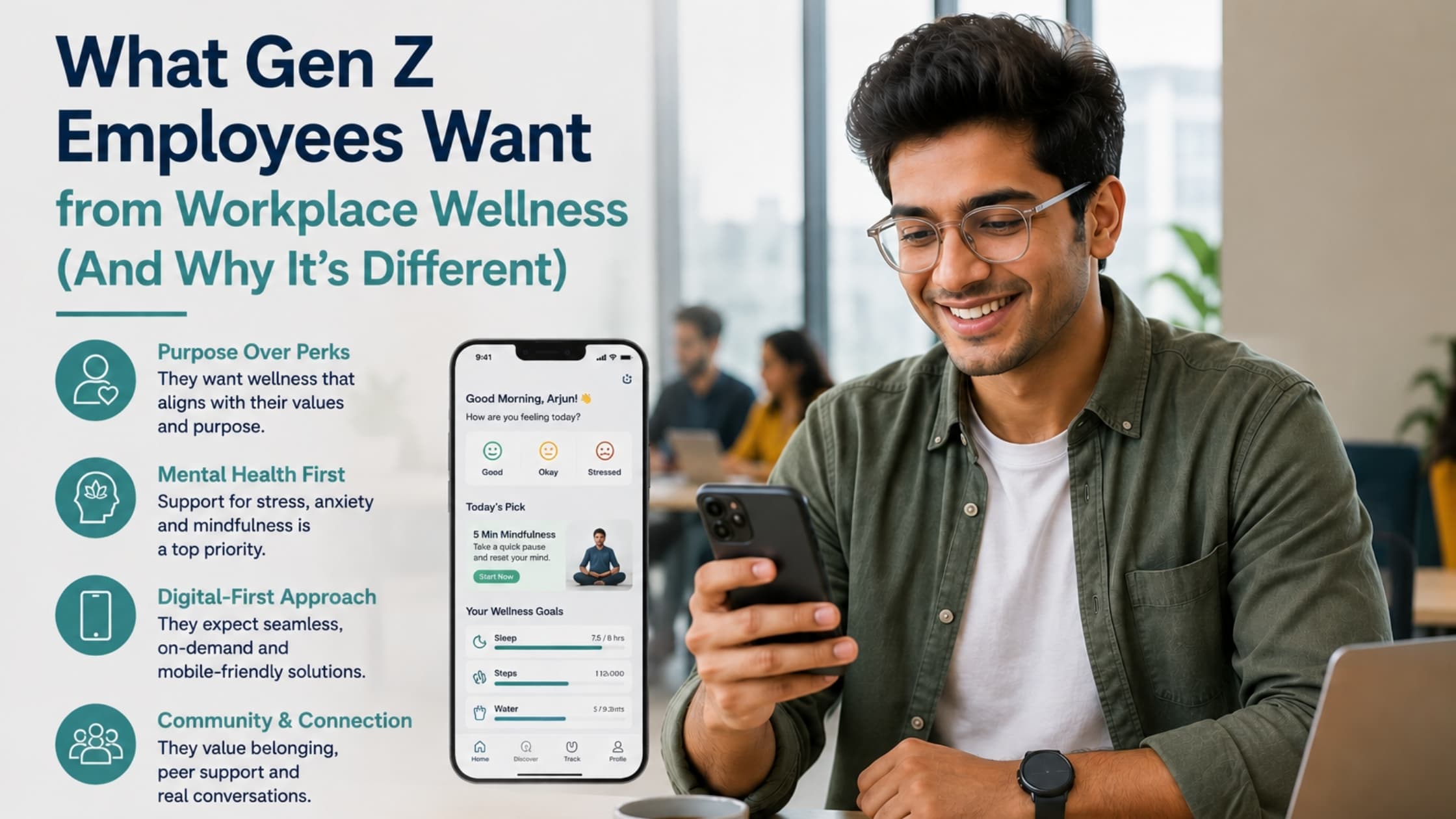
Introduction: A Generation That Changed the Rules
Imagine walking into your company's annual wellness fair. There's a booth for discounted gym memberships. Another for yoga mat giveaways. A nutritionist is handing out pamphlets on eating right. It's a decent spread — the kind of thing HR has put together for a decade. And yet, you notice that the younger employees — the ones born after 1997 — are politely glancing at the stalls and walking away, earphones in, heading back to their desks.
This isn't a hypothetical. It's playing out at companies across India right now.
Gen Z entered the Indian organized workforce in meaningful numbers from 2021, and by 2026, they represent roughly 27% of corporate employees in the country. They're now a dominant presence in tech, BFSI, consulting, and the startup ecosystem. And they carry with them a set of wellness expectations that are, frankly, foreign to the programs most employers have spent years building.
This article unpacks what Gen Z actually wants from workplace wellness — not as an opinion piece, but grounded in data, real patterns, and the lived context that explains why these preferences exist in the first place. If your organization is trying to attract and retain young talent, understanding this shift isn't optional anymore.
The Numbers Don't Lie: What Gen Z Is Telling Us
Start with the research, because the data is striking.
The Deloitte 2025 Global Millennial and Gen Z Survey found that 55% of Gen Z respondents in India said they would leave their current employer within two years if that employer didn't show a genuine commitment to mental health. That's more than half of your youngest workforce segment — not hypothetically dissatisfied, but ready to walk.
Put that in financial terms. Replacing a Gen Z hire in India typically costs anywhere from Rs 50,000 to Rs 1.5 lakh, once you factor in recruitment fees, onboarding time, lost productivity, and training. Multiply that across a high-attrition team where mental health support is absent, and the numbers become uncomfortable quickly.
"55% of Gen Z employees in India say they would leave their employer within two years if mental health support is inadequate." — Deloitte Global Millennial and Gen Z Survey, 2025
The same research, combined with a 2024 Indeed India Workforce Survey, paints a clear picture of how Gen Z ranks their wellness priorities:
- Mental health support — cited by 71% of respondents
- Work-life balance and flexibility — 67%
- Financial wellness and career guidance — 54%
- Career growth and purpose alignment — 49%
- Physical health support — 34%
Read that last number twice. Physical health — the traditional anchor of every corporate wellness program for the past twenty years — sits at the bottom of the stack. That gym membership subsidy your HR team has been promoting in job listings? Only 14% of Gen Z respondents in the Indeed survey called it an important factor in employer choice.
This isn't to say physical health doesn't matter. It does. But for this cohort, the priority order has flipped entirely. And organisations still leading with physical fitness in their wellness branding are talking to themselves.
Why Mental Health Is the Top Priority — and Why That's Not Surprising
Growing Up During a Pandemic
Gen Z didn't just experience COVID-19 as an inconvenience. They were in the middle of formative years — late teens and early twenties — when the pandemic hit. The normal developmental milestones that most professionals in their 30s and 40s took for granted: college friendships, social confidence, early career experimentation — all of that was either delayed, disrupted, or stripped away entirely.
The psychological consequences were not subtle. A 2023 NIMHANS report found that anxiety and depression rates among Indian youth aged 18–25 had risen by over 30% compared to pre-pandemic baselines. Gen Z entered the workforce already carrying a heavier mental load than any previous generation did at the same age.
Comfort With Disclosure — and the Expectation of Response
Here's the other side of the picture: Gen Z is also the generation most likely to talk about mental health openly. They've grown up watching influencers discuss therapy on Instagram. They've downloaded mindfulness apps in their teens. They've had conversations with friends about anxiety in a way that would have felt unusual — even stigmatised — for older generations.
That comfort with disclosure creates an expectation: if I'm willing to name my mental health needs, I expect my employer to meet them. An EAP helpline buried in a policy document doesn't count. A once-a-year webinar on stress management doesn't count. They're looking for something embedded in the daily experience of work — accessible, genuine, and without the sense that they'd be penalised for using it.
When a Gen Z employee asks, "Does your company support mental health?", they're not asking whether you have a policy. They're asking whether the culture makes it safe to actually need help.
The Glassdoor Effect
There's also a practical, competitive angle here. Gen Z reads Glassdoor before applying. They check LinkedIn reviews. They ask in Discord communities and WhatsApp alumni groups: "Is the mental health support at Company X real, or is it a checkbox?" The reputational damage of inadequate mental health response travels fast among this cohort, and it circulates precisely in the channels where you're trying to recruit.
Flexibility Is Not a Perk — It's the Point
The 2024 Indeed India Workforce Survey found that 58% of Gen Z respondents named flexible work hours as an important factor in employer choice, ahead of salary increments, brand name, and miles ahead of gym membership, sitting at 14%.
This deserves some context, because flexibility means different things to different people. For Gen Z, it's not primarily about working from home (though that matters). It's about trust. It's the message that "we judge you by output, not presence." That matters enormously to a generation that watched their parents, and even older siblings, burn out inside rigid 9-to-6 structures.
A Real-World Example: The Two-Company Comparison
Consider two hypothetical IT companies in Pune recruiting for similar roles at similar pay. Company A offers a standard Monday-to-Friday, 9-to-6 in-office structure with a gym subsidy and quarterly wellness seminars. Company B offers a hybrid model, flexible start times between 8 am and 11 am, access to a mental health app, and monthly one-on-ones with managers specifically about workload and wellbeing.
Among Gen Z candidates who went through both hiring processes in a recent survey conducted by a mid-sized Indian IT recruiter, Company B was preferred by 74%. Pay was identical. The difference was structure and signal.
Flexibility isn't just a scheduling preference. It's Gen Z's shorthand for: "Does this organisation trust me and respect my life outside work?" When the answer is no, they look elsewhere. And they find elsewhere.
Digital-First Isn't Trendy — It's Structural
Ask yourself: when you experience anxiety at 10:30 pm, what's accessible to you?
For most Gen Z employees, the answer is their phone. They've grown up with digital tools for everything from paying rent to filing taxes to managing their diet. The idea that a meaningful wellness resource would only be available during office hours, or require scheduling a physical appointment, doesn't fit how their lives actually operate.
Data backs this up. Headspace and Calm report that their highest usage age bracket globally is 22–28 years old. In India, mental wellness app downloads surged by over 40% in the 2023–2025 period, with the highest concentration in Tier 1 cities — precisely where most organised corporate workforces are based.
What This Means for Program Design
A wellness program that is delivered primarily through in-person seminars and physical activities has a structural access problem for this population. It's not that they dislike community or in-person engagement — it's that asynchronous, always-on digital access isn't a nice-to-have for them. It's the baseline assumption.
Practically, this means:
• Mobile-first platforms over desktop portals that require VPN access from the office
• On-demand therapy and coaching, not just scheduled sessions with long wait times
• Digital financial wellness tools, since financial stress is the third-highest driver of anxiety in this cohort
• Anonymous access options, because stigma hasn't disappeared entirely — it's just quieter
The organisations getting this right aren't necessarily spending more. They're spending differently — moving budget from subsidised gym memberships toward digital mental health platforms, flexible EAP structures, and manager training on recognising burnout early.
Financial Wellness: The Underestimated Priority
One item in the Gen Z priority stack often surprises HR leaders: financial wellness and career guidance rank third, at 54%. Higher than physical health. Close to flexibility.
This cohort entered the workforce carrying more financial anxiety than previous generations did at the same age. They've watched the cost of housing in Mumbai and Bengaluru make homeownership a remote possibility. They're navigating student loan pressures. Many are the financial support structure for extended families in a way that limits their savings capacity.
Financial wellness support — whether that's access to financial planning tools, guidance on tax-saving instruments, or even transparent conversations about career growth trajectories — addresses a real, daily source of stress. It also signals something broader: that the employer sees the whole person, not just the employee at the desk.
The most effective Gen Z wellness programs don't silo mental, physical, and financial health as separate tracks. They treat them as interconnected dimensions of a person who happens to work at your company.
What Organisations That Are Getting This Right Actually Do
A few patterns show up consistently in companies that score well on Gen Z wellness and retention:
1. They Lead With Mental Health Explicitly
Not buried in a benefits PDF — mentioned in job listings, discussed in onboarding, talked about visibly by managers and leadership. The signal is that mental health is a normal part of work life here, not something to manage privately.
2. They Build Flexibility Into the Operating Model
Not as an exception that requires approval, but as the default structure. Flexible start times, hybrid arrangements, and output-based performance measurement all fall under this. The flexibility communicates the underlying trust.
3. They Choose Digital-First Platforms for Wellness Access
An on-demand mental health app integrated with HR systems, accessible 24/7 from a personal device, is more valuable to a 24-year-old employee than a quarterly wellness day at the office. This isn't preference — it's usage data.
4. They Train Managers, Not Just Employees
Gen Z's primary workplace relationship is with their direct manager. An organisation can have the best mental health app in the market; if the manager responds to a stressed employee with "we all have tough weeks," the app doesn't matter. Manager training on mental health awareness, workload conversations, and early burnout recognition is infrastructure, not a nice-to-have.
Conclusion: The Cost of Standing Still
Corporate wellness in India is at an inflexion point. The generation now making up more than a quarter of the organized workforce has clear, well-documented preferences — and those preferences are substantially different from the ones that shaped the gym subsidies and annual health camps of the previous decade.
The organisations that adapt will do more than improve Glassdoor scores. They'll reduce attrition in a talent market where replacing a single Gen Z hire costs time and money that compounds. They'll build cultures where mental health is genuinely supported rather than performatively endorsed. And they'll be better positioned for the decade ahead, when Gen Z moves from being the youngest employees to the primary productive workforce cohort.
The ones that don't? They'll keep organizing wellness fairs where the younger employees make a polite circuit and head back to their desks. And eventually, they'll head to the door.