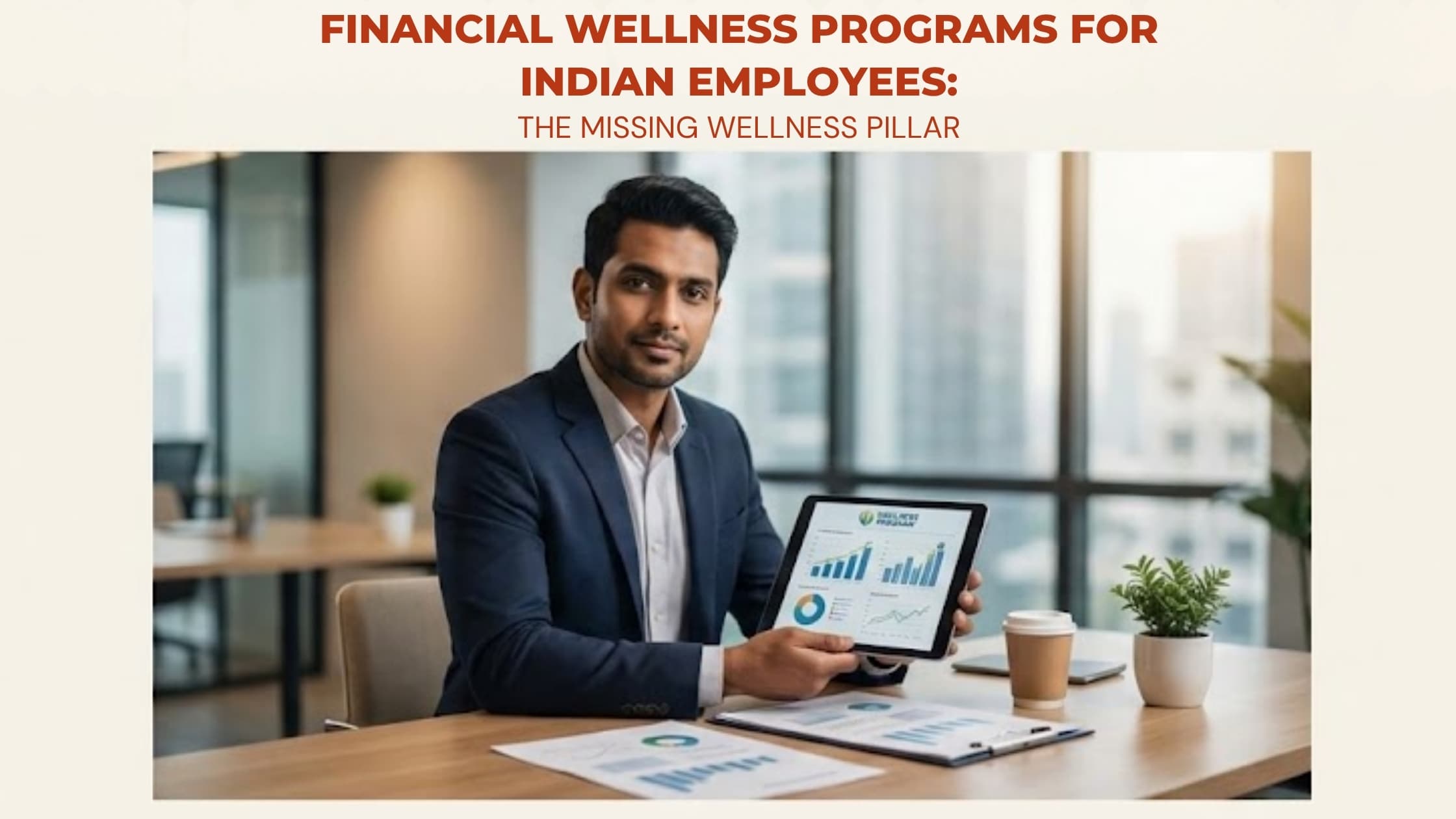
Why the one benefit most Indian employers skip is quietly costing them crores every year
Picture a mid-level software engineer in Pune — call him Arjun. He's performing well by all measurable standards: deadlines met, no attendance issues, positive peer feedback. But if you sat across from him at lunch, you'd notice he barely touches his food. His parents' medical bills arrived last week. His home loan EMI just went up after the rate revision. His daughter's school fee hike letter is sitting in his bag, unread, because he can't face the number yet.
Arjun is not struggling at work. He is struggling underneath work. And his company has absolutely no idea.
This is the invisible problem that financial wellness programs are built to address. Most Indian corporates have invested in step-count challenges, yoga sessions, and mental health helplines. Almost none have invested in helping employees manage the financial pressure that quietly degrades everything else. It is the most commonly skipped pillar of corporate wellness, and the data suggests it may be the most consequential one to skip.
How Financial Stress Actually Affects Work
A 2024 PwC India financial wellness survey produced a number that should stop every HR leader cold: employees under significant financial stress spend an average of 3.1 hours per workweek dealing with personal financial matters during office hours. That is not time stolen through bad intent. It is time lost to anxiety — to checking bank balances, fielding calls from lenders, or simply being too distracted to concentrate.
At a blended average salary cost of Rs 600 per hour, those 3.1 hours translate to roughly Rs 1,800 per employee per week — approximately Rs 90,000 per year. For a 500-person organisation, that is Rs 4.5 crore in annual productivity loss, attributable not to poor systems or weak management, but to financial stress that the company never tried to address.
The health consequences compound the problem. Financially stressed employees are 1.8 times more likely to report poor physical health, 2.3 times more likely to suffer from sleep disorders, and 1.6 times more likely to miss work due to stress-related illness. Financial pressure does not stay confined to the personal finance corner of someone's life. It floods into their sleep, their physical health, and their capacity to show up — literally and figuratively — at work.
None of this is abstract. If you have a workforce of any meaningful size, some version of Arjun is sitting in your offices right now.
What Indian Employees Are Actually Worried About
Indian financial stress has a shape that is distinct from what you would see in a Western corporate context. Most global financial wellness frameworks are designed around retirement savings and credit card debt. Those concerns exist in India too, but they sit alongside stressors that Western research does not always capture.
A 2024 Axis Bank-FICCI financial wellness study identified the top financial anxieties among Indian corporate employees:
- Inadequate emergency fund — cited by 67% of respondents
- Uncertainty about retirement savings being sufficient — 58%
- Financial obligations to parents or extended family — 52%
- Home loan EMI burden — 48%
- Children’s education costs — 44%
That third item — financial obligations to parents — is worth pausing on. In India, supporting ageing parents is not an unusual situation or a personal choice made by a few employees. It is a near-universal expectation, and for many corporate workers, it means simultaneously managing their own household expenses, a home loan, a child’s education costs, and a parent’s healthcare bills. Designing a financial wellness program that ignores this context and only addresses retirement savings is, frankly, designing the wrong program.
What an Effective Financial Wellness Program Needs to Cover
There is a temptation to equate financial wellness with a one-time seminar from a financial planner. Book a speaker, tick the box, move on. That approach produces a spike in engagement for one afternoon and changes nothing six months later. Durable programs are built differently.
Emergency Fund Building
Roughly 40% of Indian corporate employees do not have a three-month emergency fund. This single gap is the root cause of a disproportionate share of financial spirals — when an unexpected expense hits, the only option is high-cost debt. Programs that include structured guidance on building emergency savings, with employer-facilitated access to low-fee savings instruments, directly address the most common financial vulnerability in the workforce.
Investment and Tax Literacy
Most Indian employees have money sitting in savings accounts earning 3-4% while inflation runs ahead of it. Basic literacy around mutual funds, NPS contributions, ELSS instruments, and Section 80C options translates directly into better financial outcomes — without requiring employees to become investors. The distinction between financial education and financial advice matters here: the program should teach concepts and options, not prescribe specific decisions. That line keeps the program legally clean and practically useful.
EMI and Debt Management
For employees already managing home loans, personal loans, or vehicle EMIs, the practical question is not “should I take on debt” but “how do I manage the debt I have without making it worse.” Content covering balance transfer options, prepayment mechanics, and the debt avalanche versus snowball approaches gives employees actionable tools rather than abstract caution.
Retirement Planning — Earlier Than You Think
Early-career employees are the most undersaved cohort, and the most improvable one. The math of compounding is brutally clear: a 25-year-old who starts NPS contributions today will retire in a vastly different position than one who starts at 35. Programs that show employees concrete projections — “if you contribute X per month starting today, here is what your corpus looks like at 60” — drive action in a way that abstract encouragement to “save for retirement” never does.
Crisis Support
Some employees are not in planning mode. They are in crisis mode — a medical emergency, a sudden income loss in the family, a debt spiral that started from one bad decision. For these employees, access to low-cost credit options or employer emergency assistance funds can prevent the worst outcomes. Ignoring this category means the program helps employees who are already relatively stable while abandoning the ones who need it most.
How to Actually Implement It
Delivery format matters as much as content. Financial topics carry personal stigma — most employees will not raise their hand in a town hall to admit they don’t have an emergency fund. Effective programs account for this.
- Monthly 45-minute webinars on specific topics (emergency funds in month one, mutual fund basics in month two, and so on) outperform a single comprehensive annual seminar. Employees retain focused content better, and the regular cadence normalises financial conversation.
- Self-paced digital content gives employees the option to engage with sensitive topics privately, at their own pace, without anyone watching. An employee who is embarrassed about their debt situation will not attend a seminar on debt management. They will watch a 12-minute explainer video at 11pm.
- One-on-one financial consultation access — confidential, with a qualified professional — serves employees whose situations are too complex for group content. The confidentiality guarantee is not a legal formality; it is what makes employees actually use the service.
Privacy is the design principle that makes or breaks these programs. If employees suspect their employer can see whether they attended the debt management webinar, they won’t attend it. Platform architecture and consultation protocols should make data confidentiality explicit and verifiable.
The Business Case, Plainly Stated
HR teams often struggle to justify financial wellness programs to finance without a clear ROI frame. Here it is, plainly: if a 500-person organisation loses Rs 4.5 crore annually to financial-stress-driven productivity loss, and a well-structured financial wellness program reduces that loss by even 25%, the program has delivered Rs 1.12 crore in recovered productivity. Most programs cost a fraction of that.
The indirect benefits stack on top of that. Organisations that introduce financial wellness programs consistently report higher engagement in their other wellness offerings. The logic is straightforward: an employee under acute financial stress does not have the mental bandwidth to prioritise a meditation app or a fitness challenge. Once the financial pressure is addressed — or at least named and supported — the other wellness pillars become accessible in a way they weren’t before.
There is also a retention argument. Financial wellness benefits are still rare enough in Indian corporate environments that they are a genuine differentiator in talent conversations. The mid-career professional who is weighing two similar offers will notice — and remember — which employer cared enough to offer this.
The Pillar That Holds Up All the Others
Arjun, our engineer in Pune, does not need his company to manage his finances for him. He needs his company to acknowledge that money is a real and significant source of stress, and to give him tools and access that he does not currently have. That is a manageable ask. Most organisations already spend more on catered lunches than a financial wellness program would cost.
The question is not whether financial stress is affecting your workforce. It is. The question is whether you are going to keep pretending it isn’t.
Financial wellness is not a soft benefit or a nice-to-have. It is infrastructure. Build it, and the rest of your wellness investment will perform better. Skip it, and you are patching the roof while ignoring the foundation.
Key Takeaways for HR Leaders
- Financial stress costs a 500-person organisation approximately Rs 4.5 crore per year in lost productivity.
- Indian employees carry unique financial pressures — parental obligations, EMI loads, and education costs — that Western frameworks underserve.
- Effective programs combine regular webinars, private digital content, and confidential one-on-one consultations.
- Privacy in delivery is not optional — it determines whether employees actually engage.
- Addressing financial stress makes every other wellness program work better.