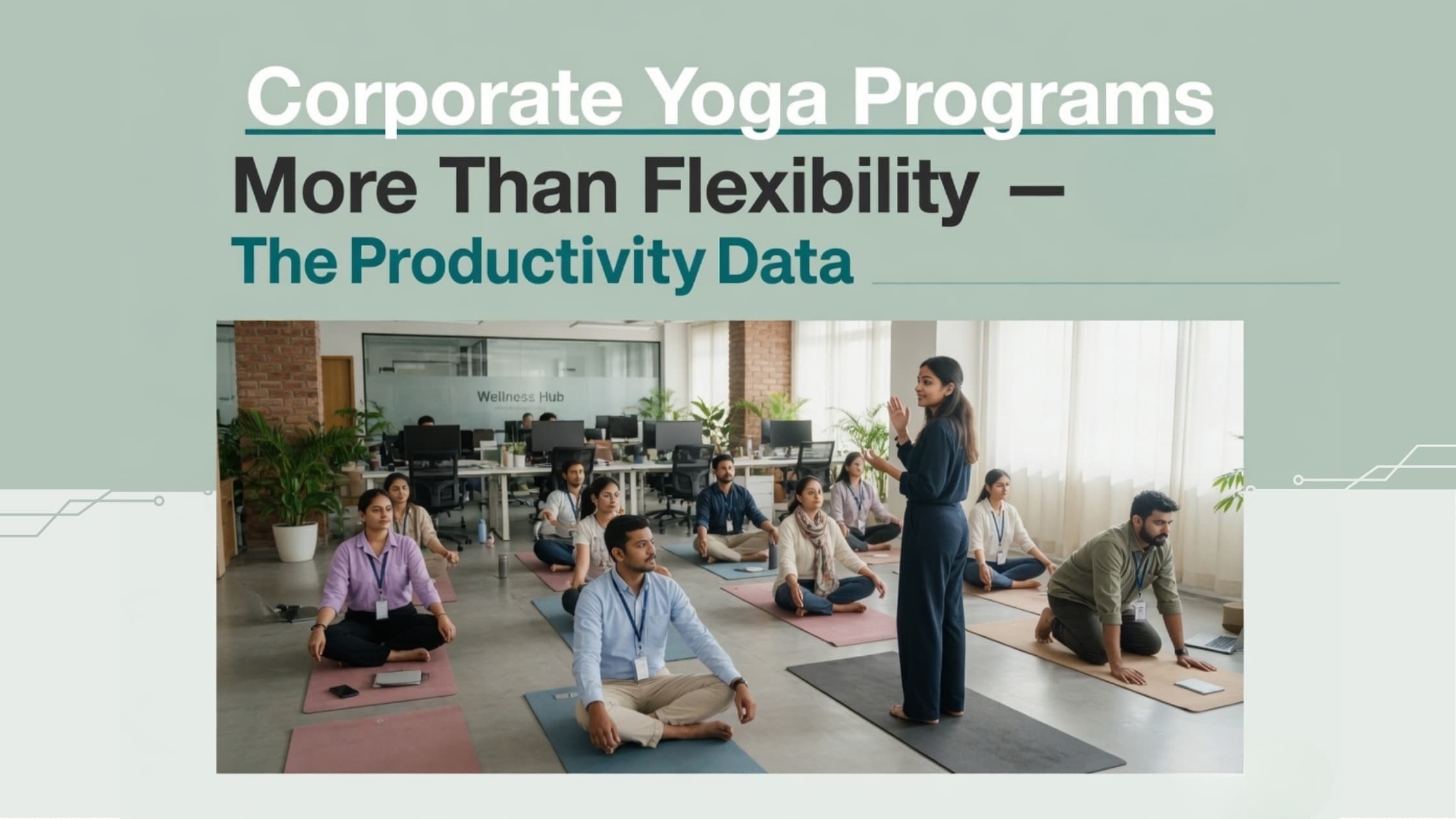
Every few months, another Indian company announces a new wellness initiative. A new yoga room, a wellness Wednesday, a morning stretch session before 9am. And every few months, the same thing happens: participation peaks in week one, halves by week three, and quietly dies by month two.
The problem is rarely yoga. The problem is design.
A corporate yoga program that requires employees to arrive 45 minutes before their shift starts — after fighting through Gurugram or Bengaluru traffic — is not a wellness benefit. It's an inconvenience dressed up as one. And yet, when organizations get the format right, the data on yoga and workplace performance is genuinely hard to ignore.
This article walks through what the research shows, the format options that actually work for Indian companies, and how HR teams can measure outcomes that go beyond attendance numbers.
What the Research Shows on Yoga and Workplace Performance
The strongest recent evidence comes from a 2023 meta-analysis published in the International Journal of Yoga, which reviewed 31 workplace yoga studies conducted across various industries. The findings are worth sitting with:
- Employees practicing yoga twice a week for eight weeks showed a 27% drop in perceived stress scores on the PSS-10 — a clinically validated scale
- Self-reported focus and concentration improved by 19%
- Sick days in the following quarter fell by 14%
- Musculoskeletal pain — the leading cause of absenteeism among desk-based IT workers — dropped by 31%
That last number deserves more attention. In India's IT sector, where engineers and analysts spend 8-10 hours seated at workstations, lower back pain, shoulder stiffness, and neck strain are near-universal complaints. They don't usually result in a sick day — they result in a distracted, uncomfortable employee grinding through the afternoon at 60% capacity.
Then there's the cortisol angle. A 2024 study from AIIMS-NIMHANS measured cortisol levels in employees who practiced a 20-minute daily yoga routine and compared them to non-practitioners. The practitioners showed significantly lower cortisol readings at 3pm — the period research consistently identifies as the highest-stress point in the typical Indian corporate workday.
Lower cortisol isn't just a clinical metric. It translates directly into better decision-making, fewer interpersonal conflicts, and more productive afternoon work blocks. For organizations where critical client calls and code reviews happen between 2pm and 5pm, this matters.
Format Options That Work for Indian Corporates
Most yoga programs fail not because yoga doesn't work, but because the delivery format ignores the realities of how Indian employees actually live and work. Here is an honest assessment of the three main formats.
Live In-Office Sessions
In-person, instructor-led yoga works well when most of your workforce is physically co-located — think large IT parks in Pune or Hyderabad, or manufacturing facilities with fixed shift structures. The social element matters: people show up partly for the group energy, and an instructor can correct posture in real time, which matters more than most HR teams realize.
The timing question is where most organizations get this wrong. Pre-work sessions — 7am or 8am — sound appealing in theory because they don't eat into work hours. In practice, they require employees to commute earlier, often significantly so. Participation drops fast.
Mid-morning (10:00 to 10:30am) or lunchtime (12:30 to 1:00pm) slots work better. A 20-to-30-minute session fits naturally into these windows without requiring employees to sacrifice a full lunch break or add time to their commute. The data backs this up: programs designed around 20-30 minute sessions consistently show higher sustained participation than 60-minute sessions.
Live Virtual Sessions
For hybrid and fully distributed teams, virtual live sessions offer something in-office programs cannot: they remove the commute barrier entirely. A 6:30am virtual session can actually get participants because no one is battling traffic to get to a conference room.
What makes virtual sessions work — and what distinguishes them from simply sending employees a YouTube link — is the group accountability. Showing up on a video call with a named instructor and colleagues creates social pressure in the healthiest sense. People come back because they know someone will notice if they don't.
The physiological benefits of virtual live yoga are comparable to in-person, according to the International Journal of Yoga meta-analysis. The modality doesn't dramatically change the outcome. The convenience significantly affects participation rates, which is ultimately what drives outcomes at scale.
On-Demand Recorded Content
On-demand is the format with the highest potential reach and the lowest guaranteed utilization. Employees who are already motivated will use it regularly and benefit from the flexibility. Everyone else will plan to use it and quietly not.
The organizations seeing real impact from on-demand programs are the ones that build motivation architecture around the content. Monthly challenges — complete 12 sessions in 30 days and earn a wellness voucher, or contribute to a team challenge — turn passive access into active participation. Without some version of this structure, on-demand content functions less like a wellness program and more like a forgotten benefit.
The strongest outcomes come from combining formats: live group sessions for connection and instructor quality, on-demand content for daily practice between those sessions. Neither works as well alone.
How to Measure Corporate Yoga Program Outcomes
HR teams often struggle to justify wellness spend because they measure inputs — number of sessions offered, percentage of employees who registered — instead of outcomes. For yoga programs, more meaningful proxies include:
- Pre- and post-program perceived stress scores using the PSS-10, run at 8-week intervals
- Self-reported musculoskeletal pain frequency tracked in monthly pulse surveys
- Session participation rates tracked per employee over a 12-month rolling window (not just aggregate counts)
- Healthcare claim patterns in the yoga-participating cohort versus non-participating cohort after 12 months
None of these are perfect. Employees who self-select into a yoga program likely differ from those who don't in ways that affect these metrics regardless of yoga. But the combination of PSS-10 scores, pulse survey data, and absenteeism tracking gives a directional picture that most leadership teams find compelling — and more honest than a participation rate presented at an all-hands.
The Design Principles That Separate Programs That Work
After reviewing the research and the format options, a few principles become clear.
Accessibility beats ambition. A 20-minute session employees can actually attend consistently outperforms a 60-minute program that looks more impressive on paper. This is obvious once stated, but almost every corporate yoga program makes the same mistake of over-engineering the ideal session and under-delivering on participation.
Timing requires empathy. The best timing for a yoga session is the timing that fits your employees' actual lives — not the timing that avoids blocking work hours or looks good in an employee survey. For a distributed team of early risers, 6:30am virtual might be ideal. For an office of parents who handle school drop-offs, 10am in-person is more realistic. Ask your employees what they want before you set the schedule.
Structure drives habits. Yoga without accountability architecture — some combination of instructor accountability, peer participation, and challenge-based incentives — relies entirely on individual motivation. Individual motivation is not a wellness program. It's a hope. The programs consistently showing impact are the ones that have built structure around the content.
Conclusion
Corporate yoga in India has a real evidence base. The stress reduction, the musculoskeletal improvements, the cortisol data — it is not soft wellness marketing. But yoga only delivers these outcomes when employees actually participate consistently, and consistent participation requires thoughtful format design, realistic timing, and motivation systems that don't assume everyone is already self-disciplined.
The organizations seeing the strongest outcomes are not necessarily the ones with the largest wellness budgets or the fanciest studio spaces. They're the ones that matched the program format to how their employees actually live and work, combined live and on-demand options, and built accountability into the program from day one.
That's the design problem worth solving. The yoga part, it turns out, takes care of itself.