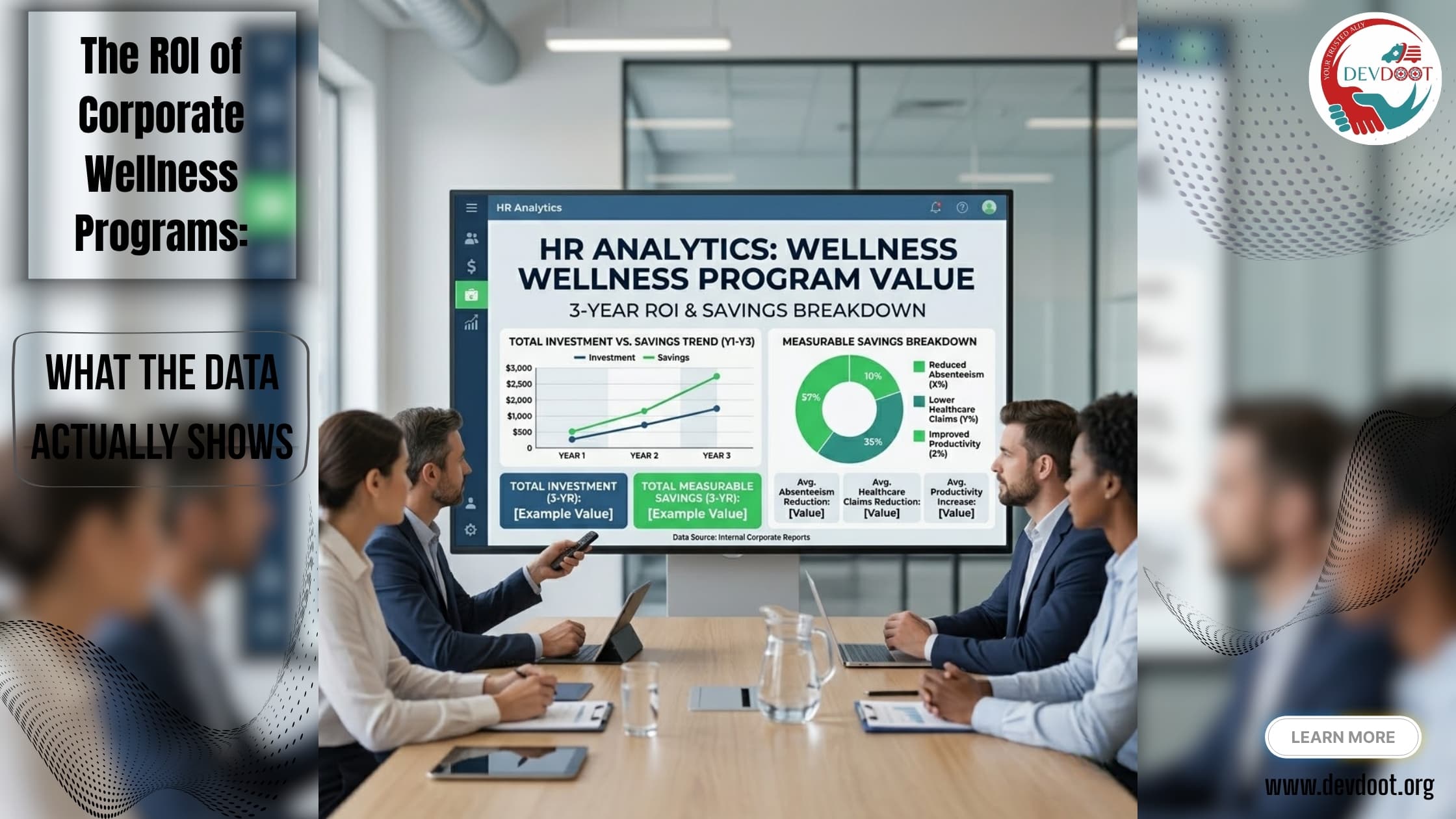
Most CHROs are asked the same question when wellness budget season arrives: prove it works. The problem is that wellness ROI is real, but the way most organizations measure it is wrong. They count gym memberships used and webinar attendance. They miss the numbers that actually matter to the CFO.
Why ROI Measurement Matters More Than the Program Itself
A 2022 RAND Corporation study found that for every dollar invested in workplace wellness, companies recover an average of $1.50 in reduced absenteeism costs alone, before accounting for productivity gains or lower insurance premiums. In India, where absenteeism costs organizations an estimated Rs 1.8 lakh per employee per year across sectors, the math compounds quickly.
The challenge is attribution. Wellness programs operate over months and years, while finance teams want quarterly numbers. The organizations that win the budget argument are those that instrument their programs from day one — tracking metrics that translate directly into rupees and cents.
5 Metrics That Actually Move the Needle
1. Absenteeism Rate
Track unplanned absence days per employee per quarter. Benchmark: Indian IT sector averages 4.2 unplanned absence days per employee annually. Companies with active wellness programs report 2.1 to 2.8 days — a reduction worth Rs 45,000 to Rs 70,000 per employee per year at average IT salary levels.
2. Healthcare Claims Frequency
Group health insurance premiums in India are driven by claims history. Organizations that reduce per-employee claims by 15% typically see renewal premiums drop 8 to 12% the following year. With group insurance costing Rs 8,000 to Rs 25,000 per employee annually, a 10% reduction on a 500-person workforce saves Rs 4 to Rs 12.5 lakh per year — from one metric alone.
3. Presenteeism Score
Presenteeism — employees physically present but mentally disengaged — costs Indian companies more than absenteeism does. A Harvard Business Review analysis found presenteeism accounts for 57% of total lost productivity costs. The Stanford Presenteeism Scale (SPS-6) is a validated six-question survey you can run quarterly at zero cost.
4. Employee Net Promoter Score (eNPS)
eNPS tracks whether employees would recommend your organization as a place to work. Gallup data shows a 10-point improvement in eNPS correlates with a 4.1% reduction in turnover. At Rs 50,000 to Rs 1.5 lakh in replacement costs per position (depending on seniority), retaining even five employees annually pays for a mid-range wellness program.
5. Productivity Index
Define this for your organization: output per head, tickets resolved, units produced, or revenue per FTE. The specific metric matters less than consistency. Establish a baseline before your program launches, then track quarterly. Companies in the Humanova network report an average 12% productivity improvement in the first year of a structured wellness program.
India-Specific Data: What Local Research Shows
The 2023 Assocham India Employee Health study found that 48% of Indian employees report their productivity is directly affected by physical or mental health issues. A separate Deloitte India survey found that companies with dedicated mental health programs see 6x better employee retention than those without. These are not soft numbers — they feed directly into the cost models that CFOs care about.
Industry variation matters too. BFSI sector organizations report the highest per-employee wellness ROI, averaging Rs 3.20 returned per rupee invested, largely due to the high cost of replacing trained compliance and sales staff. Manufacturing companies see ROI concentrated in injury prevention and sick day reduction, typically Rs 1.80 to Rs 2.40 per rupee. IT and services firms land in between, with ROI driven primarily by retention and presenteeism improvement.
Building the Business Case
The strongest wellness ROI presentations to leadership include three elements: a baseline cost calculation (what current poor health is costing the organization today), a program cost projection (total investment over 12 and 36 months), and a conservative recovery model (using the lower bound of published data, not averages).
Present the break-even point explicitly. Most structured corporate wellness programs in India reach break-even within 8 to 14 months when absenteeism and healthcare cost reductions are included. Beyond break-even, the productivity and retention benefits are net gain.
Conclusion
The ROI of corporate wellness is real, but only for organizations that measure it deliberately. Start with absenteeism and healthcare claims — they are the fastest to move and easiest to monetize. Build the measurement framework before the program launches, not after. The companies that struggle to prove wellness ROI are almost always the ones that started tracking after the fact.