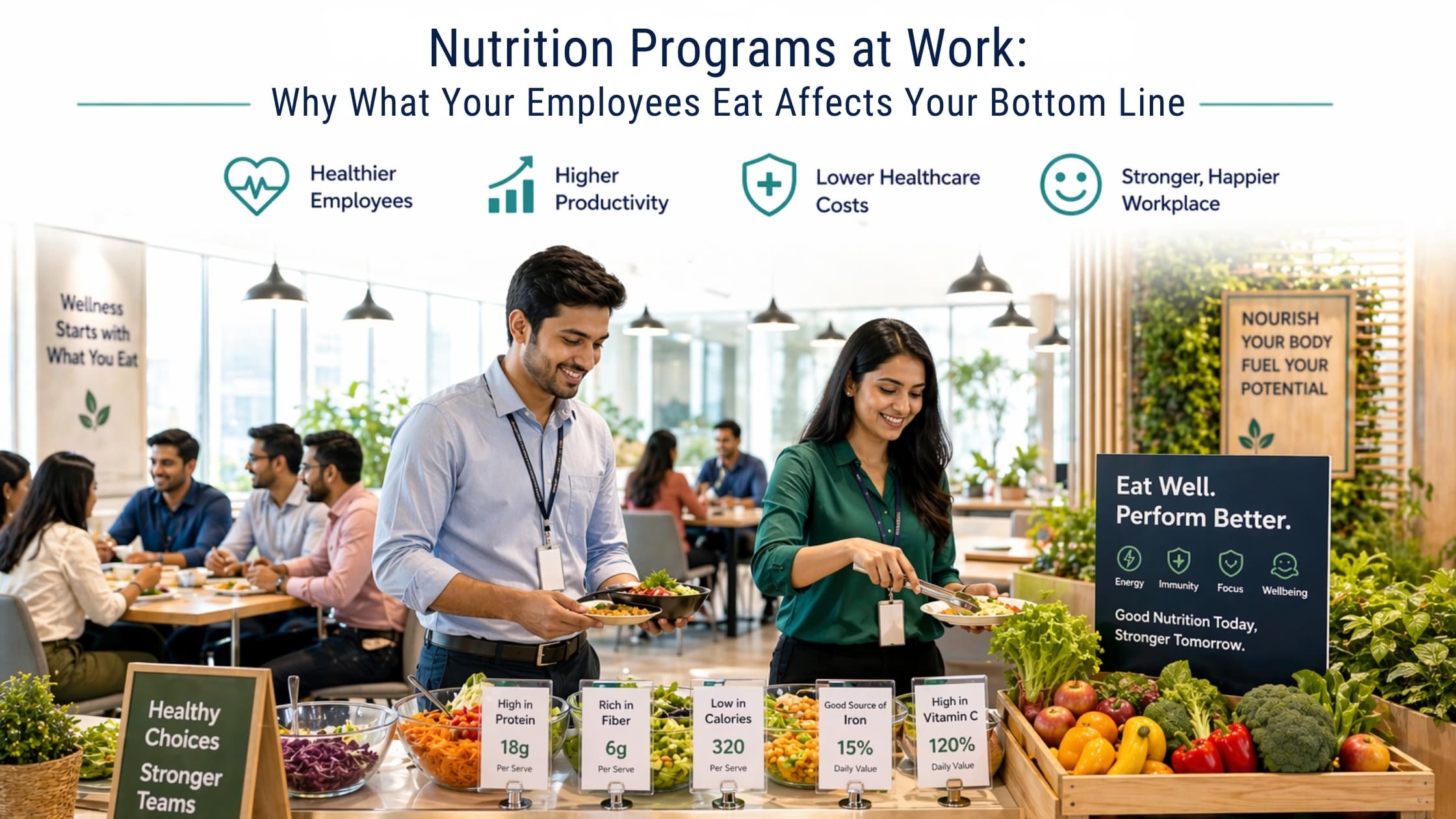
Here is a question most HR leaders have never been asked in a board meeting: what did your employees eat for lunch today?
It sounds trivial. It isn't. What sits on the plate at 1 PM has a measurable effect on the quality of thinking that happens from 2 PM onward — and in a country where nearly 77 million people have Type 2 diabetes and millions more are pre-diabetic without knowing it, the cafeteria is one of the most overlooked levers of workforce productivity available to Indian organizations.
The WHO, in a 2012 study, found that adequate nutrition can raise individual productivity by as much as 20 percent. That is not a marginal gain. For a 500-person company, even a 10-percent improvement in afternoon output compounds into a meaningful annual difference. And yet most corporate wellness budgets in India spend heavily on gym subsidies and step-count challenges while the cafeteria serves white rice, maida-based snacks, and sugary chai by the litre.
This piece is about fixing that imbalance.
The Post-Lunch Crash: Not Just a Habit, a Biochemical Event
Almost every Indian office worker knows the feeling. The meeting that starts at 2:30 PM where half the room is fighting to stay present. The emails that take twice as long to write. The decisions that get pushed to tomorrow because the brain simply refuses to work at full speed.
This is commonly blamed on laziness or a heavy meal. The reality is more specific. The post-lunch dip is partly a circadian rhythm effect — the body has a natural drop in alertness in the early afternoon — but the severity of that dip is heavily influenced by what was eaten.
A meal centered on high-glycemic foods — white rice, white bread, refined flour rotis, sugary drinks — causes a rapid spike in blood glucose followed by a sharp drop. That crash lands right on top of the natural circadian dip, compounding it. Research from the University of Cambridge found that employees who ate high-fiber, lower-glycemic lunches showed 22 percent higher cognitive performance in the afternoon compared to those who ate high-GI meals. The difference was not subtle; it was measurable in problem-solving speed, decision quality, and sustained attention.
Indian corporate cafeterias, on average, are not set up to prevent this. The default meal is rice or roti with a dal and sabzi — not inherently unhealthy, but often served with large portions of refined carbs, minimal fiber, and almost no protein-forward options for those who want them. Add to that the ubiquitous cold drinks fridge and the afternoon chai-and-biscuit culture, and you have a nutritional environment that actively sets employees up for a productivity slump every single day.
"22% higher afternoon cognitive performance — from a lunch choice. That is not a wellness statistic. That is a business metric."
India's Diabetes Burden Is a Workplace Performance Problem
India is the diabetes capital of the world. That description appears in public health reports frequently enough that it has almost lost its impact. For corporate HR leaders, it should not.
The American Diabetes Association found that employees with uncontrolled Type 2 diabetes lose an average of 2.5 hours of productive time every single workday. Not to sick leave — to presenteeism. They are at their desks, but cognitive impairment from blood sugar fluctuations, fatigue from poor metabolic control, and time spent managing symptoms quietly erode their output.
Now consider that in a typical Indian corporate workforce, a meaningful share of employees — often far more than any health survey reveals — are either diabetic, pre-diabetic, or metabolically at-risk without a formal diagnosis. ICMR data suggests pre-diabetes rates in Indian urban adults are high and rising, and most people in this category do not know their status.
A targeted nutrition program does not cure diabetes. But it can meaningfully slow the progression of pre-diabetes, improve glycemic control in those already diagnosed, and reduce the daily productivity drag that unmanaged metabolic conditions create. It is, in effect, a form of preventive health infrastructure — one that pays dividends in reduced absenteeism, lower healthcare claims, and better day-to-day performance.
What a Corporate Nutrition Program Actually Looks Like
The words 'nutrition program' can conjure images of expensive dietitian retainers, elaborate cafeteria overhauls, and wellness retreats nobody has the budget for. The practical reality is much more accessible.
A well-designed corporate nutrition program in India operates at three levels, each with its own cost and reach profile.
Level 1: The Cafeteria Audit
Start here. Engage a registered dietitian — not a generalist nutritionist, a dietitian with clinical credentials — to evaluate your cafeteria menu against the ICMR Dietary Guidelines for Indians (2024 edition). The goal is not to eliminate anything beloved, but to shift the balance.
Simple, low-cost changes can move the needle significantly. Adding more lentil-based dishes (dal, rajma, chana) boosts protein and fiber. Reducing refined carbohydrate portion sizes while increasing vegetable and salad availability shifts the glycemic load of the average meal. Replacing sugary beverages at the drinks station with infused water, nimbu pani without added sugar, or plain chaas cuts out one of the biggest hidden sugar sources in the Indian office diet. Displaying a simple nutritional information card next to each dish — even just calories, protein, and fiber — helps employees make more informed choices without feeling lectured.
None of this requires a menu revolution. It requires intention. The cost is primarily the dietitian's consulting fee for the audit and redesign, which is typically a one-time engagement.
Level 2: Education and Behavioural Nudges
Once the environment improves, layer in programming to change habits over time. Monthly nutrition webinars — 30 minutes, focused on practical topics like 'how to eat well when ordering from Swiggy or Zomato' or 'what to eat before and after exercise' — are consistently well-attended when kept practical and non-preachy.
Desk-friendly snack guides work well in sales and operations teams where people eat at their workstations. A laminated card or a Slack-pinned message listing 10 snacks that do not cause a sugar crash is genuinely useful. Small details like this respect that employees are busy and meet them where they are rather than asking them to change their entire relationship with food.
Internal communications matter too. A company that regularly shares recipes, celebrates Nutrition Month in September, or posts a 'Monday Meal Prep' tip in its internal newsletter signals that nutrition is part of the culture — not just another compliance checkbox.
Level 3: Individual Nutrition Coaching
For organizations with more robust wellness budgets, or for specific employee cohorts like high-stress leadership teams or employees flagged through health screenings with elevated HbA1c, individual nutrition coaching delivers the most personalized impact.
Platforms like Humanova's NutriGuide feature allow organizations to offer one-on-one guidance from registered dietitians at scale — employees interact via app-based consultations, meal logging, and personalized recommendations without requiring the company to build an in-house team. The cost per employee is a fraction of what most companies spend on outpatient health insurance claims for metabolic conditions.
How to Tell If It Is Working
Wellness investments fail to gain traction partly because they are hard to measure. Nutrition programs are no exception, but proxy metrics exist if you know where to look.
- Self-reported afternoon energy levels tracked via monthly wellness pulse surveys. A simple 1-5 rating on 'How is your energy in the afternoons?' costs nothing and trends clearly over time.
- HbA1c levels in the employee population, trackable through annual health screenings. A reduction in the percentage of employees in pre-diabetic or diabetic HbA1c ranges is a direct metabolic outcome.
- Cafeteria participation rates for healthier options versus less healthy alternatives. If the lentil bowl outsells the fried snack counter after six months, something is working.
- Healthcare claims for metabolic conditions year over year. This is the long-term ROI metric that speaks directly to finance leadership.
None of these require sophisticated analytics infrastructure. They require consistency — tracking the same things every year so trends become visible.
The ROI Argument, Plainly Put
A basic cafeteria menu optimization costs roughly what a two-month gym subsidy costs. The difference is that the cafeteria reaches every employee who eats there — including the 80 percent who will never set foot in a corporate gym. For a large organization, improving the nutritional quality of the average lunch served is possibly the highest-reach, lowest-cost wellness intervention available.
Layer in a monthly webinar series — a few hours of a dietitian's time — and you have a program with measurable behavioral reach. Add individual coaching for at-risk employees and you have a clinically defensible intervention that reduces healthcare costs over a three-to-five year horizon.
The math is not complicated. What is missing, in most Indian organizations, is the will to treat food as a performance variable rather than a facilities concern.
Final Thought
The link between nutrition and productivity is not a hypothesis. It is documented, replicated, and directly applicable to the Indian workforce context. The barriers to action are cultural and organizational, not financial or logistical.
Starting with a cafeteria audit is low risk, low cost, and immediate in impact. It does not require a board-level mandate or a restructured wellness budget. It requires a single decision: to take food seriously as part of how your organization performs.
The post-lunch slump in your office is not inevitable. It is dietary. And it is fixable.