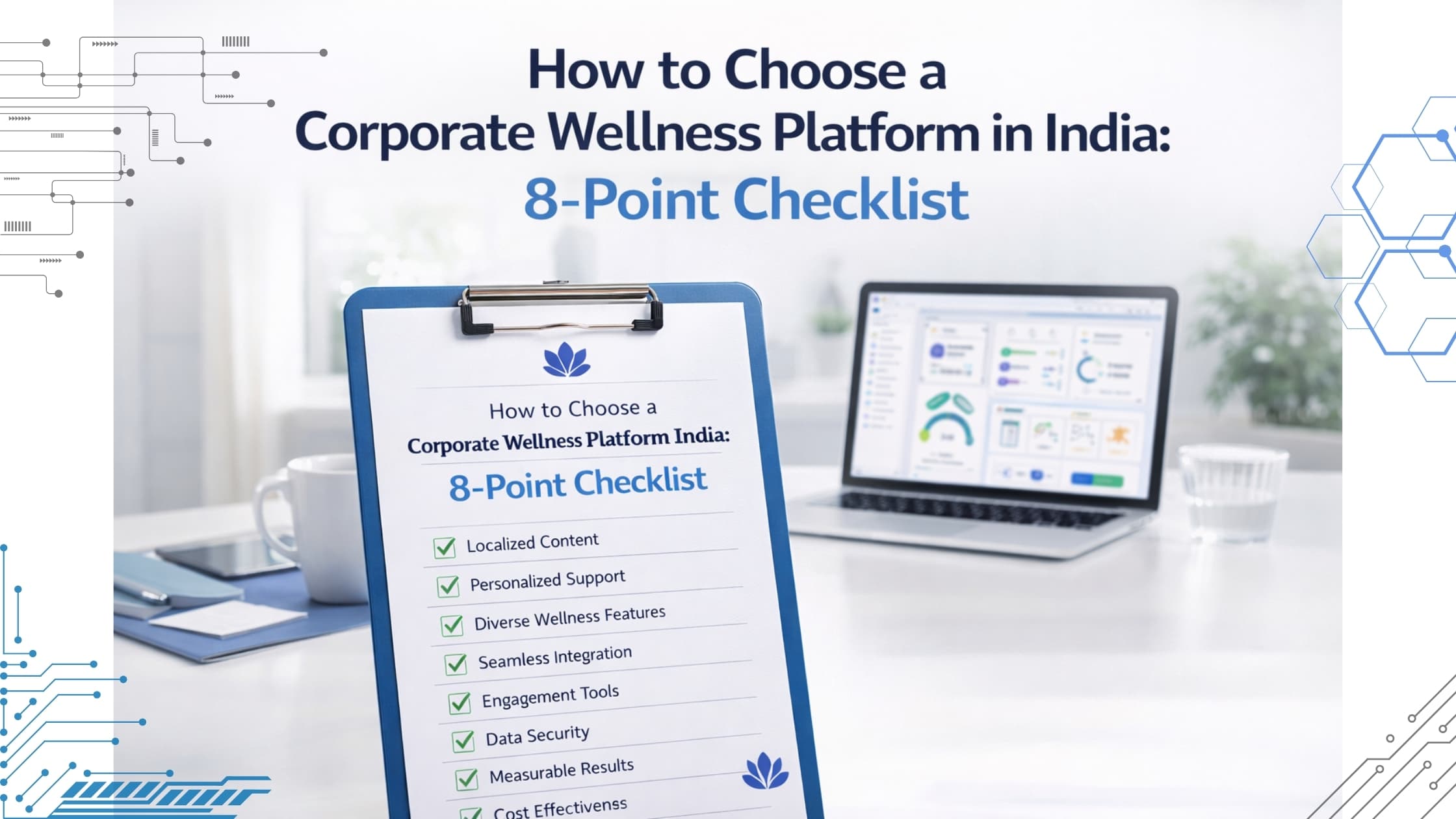
The Indian corporate wellness platform market has grown from approximately 15 vendors in 2019 to over 80 in 2026. Not all of them are built for the Indian context, meet current data privacy standards, or deliver the engagement rates they promise. This checklist cuts through the noise.
Point 1: Engagement Rate Benchmarks
Ask every vendor for their average monthly active user rate across their India client base. The industry benchmark for a well-designed platform is 35 to 50% monthly active users of enrolled employees. If a vendor cannot give you this number, or cites it for global rather than India deployments, treat it as a red flag. Platform engagement is the prerequisite for every wellness outcome — a platform that employees don't use cannot help them.
Point 2: India-Specific Content Depth
Wellness content matters when it resonates. Check for: Indian language availability beyond English and Hindi (Tamil, Telugu, Kannada, Bengali are the priority languages for large corporate workforces), content that addresses India-specific stressors (family obligation pressure, financial anxiety about dependents, commute stress, workplace hierarchy dynamics), and Indian practitioner expertise on the platform — not just global content re-skinned for India.
Point 3: Clinical Credibility
The wellness platform market includes providers that employ licensed clinical psychologists and those that employ 'wellness coaches' with minimal training. For any platform offering mental health support, verify: are counselors licensed by the Rehabilitation Council of India or hold equivalent clinical qualifications? What is the average caseload per counselor? (Above 30 active clients per counselor per month compromises quality.) Is there clinical supervision of counselors?
Point 4: PDPB 2023 Compliance and Data Privacy
India's Personal Data Protection Bill 2023 classifies health data as sensitive personal data with specific requirements for consent, storage, and processing. Any wellness platform handling employee health information must be compliant. Ask vendors specifically: where is health data stored (India or offshore)? Who has access to individual employee health data? How is aggregate reporting generated in a way that protects individual privacy? What is the data deletion protocol when an employee leaves?
Point 5: HRMS Integration Capability
A wellness platform that does not connect to your HRMS creates manual administration overhead and data gaps. The common HRMS platforms in India's corporate market: SAP SuccessFactors, Darwinbox, Keka, Zoho People, Workday, and Oracle HCM. Verify that the wellness platform has documented, working integrations with your specific system — not just a claim of API capability. Ask for a reference client using your HRMS combination.
Point 6: Reporting and Analytics
The reporting your CFO will ask about: per-employee wellness spend versus industry benchmark, absenteeism trend data correlated with wellness program participation, healthcare claims frequency trend, and engagement metrics by department and manager. If a vendor's reporting dashboard cannot produce these views without custom development, budget for that or find a vendor with better native analytics.
Point 7: Pricing Model Transparency
Common pricing models in India's wellness platform market: per employee per month (PEPM) — typically Rs 100 to Rs 500 depending on feature set; annual license with per-head scaling; or modular pricing where you pay for specific pillars (physical, mental, financial) separately. Watch for: minimum contract lengths above 12 months for a first engagement, per-utilization pricing that creates budget unpredictability, and hidden setup or integration costs. Get total year-one cost in writing before signing.
Point 8: Customer Success and Support
Platform quality matters less than you think when implementation support is poor. Ask: will you have a dedicated customer success manager, or a shared support queue? What is the average onboarding timeline for a company your size? Can they provide references from three Indian clients with similar employee counts who launched in the past 18 months? A vendor's willingness to provide recent India references is one of the strongest signals of actual deployment quality.
Conclusion
Platform selection is not primarily a technology decision — it is a vendor relationship decision. The best platform for your organization is the one whose support model, content depth, and measurement capabilities match your specific workforce and wellness goals. Take the time to evaluate against this checklist before signing.