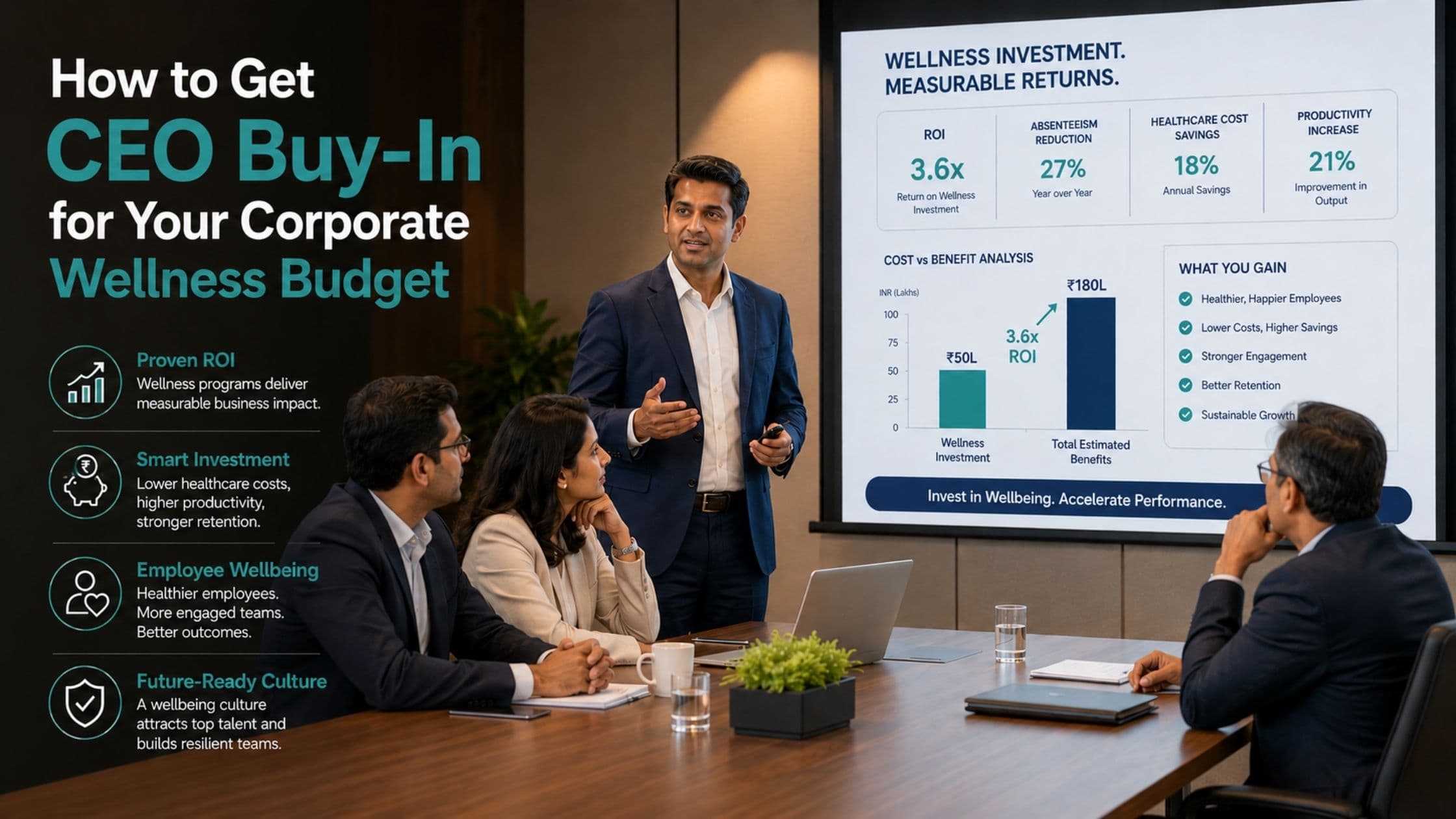
You have spent three weeks building a wellness proposal. The data is solid. The vendor quotes are in. You know this program will reduce absenteeism, lower attrition, and make the company measurably more productive. You walk into the boardroom, click to slide one — and within ninety seconds, you can see the CFO checking his phone.
You did not lose the room because your data was weak. You lost it because you were speaking the wrong language.
This happens constantly in corporate India. HR leaders who genuinely understand the value of employee wellbeing present to C-suite executives whose primary job is to protect margins and justify spend to a board. The gap between those two worlds is not about values — most CEOs actually do care about their people. The gap is about translation. Wellbeing language does not convert into budget language automatically. You have to do that work before you walk in the room.
This guide gives you the exact framework to do it.
Why Most Wellness Budget Pitches Fail Before Slide Two
There is a pattern to the failed pitch. It usually opens with something like: "We want to invest in our people's wellbeing to improve engagement and build a culture of health." Every word in that sentence is true. Every word also sounds like a cost center to a CFO who is managing EBITDA pressure in a tough quarter.
The deeper problem is framing. When you open with wellbeing outcomes, you are implicitly asking the executive to trust that those outcomes will translate into financial results. You are asking them to make an inferential leap — and senior executives, especially finance-oriented ones, do not want to make inferential leaps on unproven territory. They want the math in front of them.
Consider how different the same proposal feels when you open instead with: "We are currently spending approximately Rs 2.4 crore per year in costs directly attributable to preventable employee health issues and unplanned absenteeism. A structured wellness intervention at Rs 35 lakh annually reduces that by a conservative 25%, returning Rs 60 lakh in year one alone."
Same program. Completely different conversation.
Lead With the Cost of Doing Nothing
The single most effective shift you can make in your wellness pitch is to open with the cost of inaction rather than the cost of the program. This is not a rhetorical trick. It is an accurate framing of what is actually happening: your organization is already paying for poor employee health. The question is not whether you spend money — it is whether you spend it reactively or proactively.
The Numbers That Actually Exist in Your Organization Right Now
Most HR leaders can pull these figures with a few days of groundwork:
- Absenteeism cost: average sick days per employee multiplied by average daily productive value (salary plus overhead)
- Voluntary attrition cost: industry benchmarks in India put replacement cost at 50-75% of annual CTC for mid-level roles, and 100-150% for senior roles — including recruitment fees, onboarding time, and productivity ramp
- Healthcare claims trend: if your company has a group health insurance policy, your insurer can provide three-year claims data; a rising trend is a quantifiable liability
- Productivity drag: benchmark your output-per-head against high-wellness competitors in your sector — the gap is a number
Add those figures. Put a single rupee total at the bottom. That total is the real opening number of your presentation. It is what staying the course actually costs every year.
A mid-size IT services firm in Gurugram ran this exercise before their wellness budget review and found that preventable absenteeism alone was costing Rs 1.8 crore annually — more than four times their proposed wellness budget. The budget was approved within two weeks of the presentation.
Speaking the Language of the C-Suite
Language choices matter more than you might think in budget conversations. The same metric framed two different ways will land completely differently across the table.
The Translation Guide
- Say "payback period" — not "investment timeline"
- Say "cost per head" — not "per-employee spend"
- Say "EBITDA impact through productivity recovery" — not "engagement improvement"
- Say "attrition cost avoidance" — not "retention improvement"
- Say "claims cost reduction" — not "healthcare support"
- Say "output per employee indexed at current headcount" — not "productivity boost"
The reason this matters is not superficial. These specific phrases trigger different mental models. "Engagement improvement" lives in soft HR territory. "Attrition cost avoidance" lives in P&L territory. Same underlying outcome. Entirely different credibility signals.
Take it further: every wellness metric you present should have a rupee equivalent attached to it. An employee Net Promoter Score improvement of 10 points is not an abstract feel-good number. At a 500-person company with an average CTC of Rs 12 lakh and a 18% voluntary attrition rate, that score improvement correlates to approximately Rs 45-60 lakh in annualized attrition cost avoidance, depending on the published correlation coefficients for your industry. Do that math. Show it. Make the executive do the arithmetic with you.
The 3-Slide Framework That Works
You do not need a 25-slide deck. In most C-suite settings, a dense presentation signals that you are not sure which argument is strongest. Three focused slides, each doing one job, is more persuasive than ten.
Slide 1: The Cost of the Current State
This slide contains only numbers. No program recommendations, no vendor names, no photos of happy employees doing yoga. The job of this slide is to make the cost of inaction viscerally clear.
- Current annual absenteeism cost: Rs X lakh
- Current annual voluntary attrition cost (fully loaded): Rs X crore
- Healthcare claims trend over three years: Rs X to Rs Y (rising by Z%)
- Estimated productivity gap versus wellness-mature competitors: Rs X crore
Total at the bottom. Bold. This is your anchor. Everything else is a response to it.
Slide 2: The Investment and Return
This is where the program appears — but it appears as a financial model, not a program description. Structure it like a business case:
- Program cost per year: Rs X lakh
- Year-one projected cost reduction (conservative 25% impact): Rs Y lakh
- Year-one net return: Rs Z lakh
- Break-even point: X months
- Three-year cumulative ROI: Rs X crore at conservative assumptions
Include a sensitivity line: "Even at 50% of projected impact, we break even in 14 months." This handles the skepticism before it is voiced. It signals that you have stress-tested your own numbers — which immediately separates you from every other HR pitch the CFO has sat through.
Use published India benchmarks where possible. The Confederation of Indian Industry (CII) has published data on wellness ROI in the Indian corporate context. Cite them. Grounding your numbers in third-party sources removes the objection that you are projecting what you want to see.
Slide 3: The Measurement Plan
This slide is the one most HR leaders skip, and it is the one that closes the deal.
CEOs and CFOs have been burned before by wellness and engagement programs that promised outcomes and had no way to prove them. A measurement framework before you ask for money tells the room something important: you are accountable. You are not asking them to trust you — you are asking them to hold you to specific numbers.
Your measurement plan should specify:
- Which KPIs you will track quarterly (absenteeism rate, voluntary attrition, healthcare claims, productivity index)
- How you will attribute changes to the wellness program versus other variables
- At what threshold you will recommend scaling, modifying, or discontinuing the program
- Who receives the quarterly report and in what format
That last point matters. An executive who knows they will see a quarterly number tied to a budget line is an executive who is engaged in the program's success. You have turned a one-time approval into an ongoing conversation.
Handling the Objections You Will Actually Get
There are four objections that come up in almost every wellness budget conversation in India. Here is how to handle each one without being defensive.
"We cannot afford it right now"
Do not argue with the budget constraint. Instead, return to the cost-of-inaction slide and ask: "What is the cost of waiting 12 months?" If the current state is costing Rs 1.8 crore annually, then deferring the program costs roughly Rs 1.8 crore in avoidable losses — plus whatever inflation does to replacement costs and claims. The question reframes affordability.
You can also offer a phased implementation: "We could start with our highest-attrition business unit at Rs 8 lakh this quarter, run a 90-day measurement cycle, and bring you the actual results before committing to a full rollout." Smaller commitments with clear checkpoints reduce perceived risk significantly.
"We tried something like this before and it did not work"
This one requires real curiosity, not defensiveness. Ask what was measured and how participation was tracked. In almost every case, the previous program failed either because there was no measurement framework at all, participation was voluntary and attendance was low, or the program was vendor-led without internal ownership.
Address those specifically. Show how your proposal is structurally different: built-in measurement, defined participation targets, internal HR accountability, not just a vendor contract.
"Employees should manage their own health"
This is a values objection, and it deserves a data response. Financial stress, which affects approximately 62% of urban Indian employees according to multiple workforce surveys, does not stay outside the office door. It shows up as presenteeism — employees who are physically at their desks but cognitively elsewhere.
The organization is already paying for employee financial and physical stress through lost productive time, judgment errors, and interpersonal friction. The wellness budget does not create that cost. It reduces a cost that already exists.
"How do we know this will actually work?"
Offer a pilot. One business unit. 90 days. Defined metrics. A clear review before committing to full rollout. A pilot answers the question better than any guarantee you could offer — it produces actual internal data from your organization, which is more convincing than any external benchmark.
One More Thing Before You Walk In
Find out who your real ally in that room is. In some organizations it is the CFO who is acutely aware of attrition costs and healthcare claims trends. In others it is the CEO who has already been convinced by something they read, and just needs a credible internal plan to approve. In others it is the CHRO who will champion the proposal but needs better financial language to work with.
Brief that person before the meeting. A proposal that already has one executive supporter in the room lands very differently from one that is seeking its first convert.
The Bottom Line
Budget conversations are won with numbers, not narratives. The HR leaders who consistently get wellness budgets approved in India are not the ones with the most comprehensive proposals or the most compelling vendor decks. They are the ones who sat down with a spreadsheet, quantified the cost of the current state, translated every wellness metric into its financial equivalent, and walked in with a measurement plan that held them accountable.
That is not a communication trick. It is intellectual honesty — about what the organization is already spending, what the program will actually deliver, and how you will know if it is working.
The C-suite will respond to that. Because that is exactly how they think about every other investment decision they make.